Why Your Child Says "I Can't" (And How to Help)
Why Your Child Says "I Can't" (Even When They Probably Can)

Quick Answer
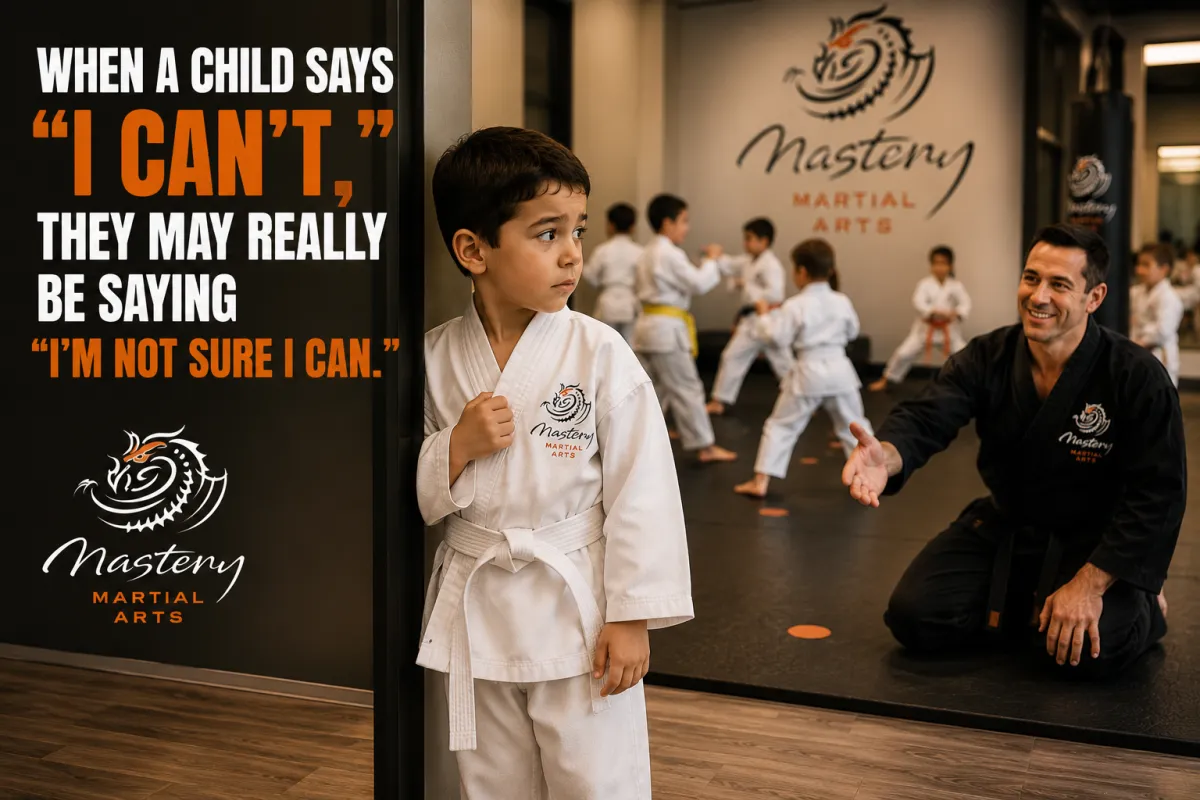
When a child says,"I can't,"they're usually not describing their ability—they're describing how they feel. Fear of making mistakes, uncertainty, frustration, or a lack of confidence often sounds like "I can't." The good news is that confidence isn't something children are born with. It's built through small successes, encouragement, and learning that they can do difficult things one step at a time.
Key Takeaways
"I can't" is usually a confidence problem, not an ability problem.
Confidence grows through experiences, not simply encouragement.
Children borrow belief from trusted adults before believing in themselves.
Small wins create lasting self-confidence.
Parents can respond in ways that build resilience instead of dependence.
What You'll Learn
By the end of this article you'll understand:
Why children say "I can't."
What's happening emotionally beneath those words.
How to respond without arguing or rescuing.
Five practical ways to help your child develop confidence.
How Mastery Martial Arts helps children replace "I can't" with "I did it."
"I Can't."
It's one of the smallest sentences a child can say.
Yet for many parents...
it's one of the hardest to hear.
Maybe it's while tying shoes.
Starting homework.
Walking onto a soccer field.
Introducing themselves to another child.
Learning to ride a bike.
Or stepping onto a martial arts mat for the very first time.
Many parents immediately try to convince their child.
"You can."
"You'll be fine."
"Just try."
Those words come from love.
But they rarely change what the child is feeling.
Because "I can't" usually isn't about the task.
It's about the belief they have about themselves.

"I Can't" Is Usually a Feeling—Not a Fact
Children naturally experience moments of uncertainty.
Their brains are still learning how to manage frustration, regulate emotions, and interpret challenges.
When something feels uncomfortable, the brain often reaches a quick conclusion:
"Maybe I'm just not good at this."
That thought becomes...
"I can't."
It sounds like ability.
But it's really self-doubt.
What the Research Says
Psychologist Albert Bandura introduced the concept of self-efficacy, which describes a person's belief in their ability to succeed. His research showed that confidence grows primarily through successful experiences—not simply from encouragement.
Similarly, Dr. Carol Dweck's research on growth mindset found that children who believe abilities can improve through practice are much more likely to persist after setbacks than children who believe talent is fixed.
In other words...
Children become confident because they experience themselves overcoming challenges.
Not because someone repeatedly tells them they're capable.

The Difference Between Confidence and Ability
Many parents unintentionally confuse confidence with competence.
Confidence Ability
Believing you can try
Having developed the skill
Comes before success
Comes after practice
Built through experiences
Built through repetition
Allows children to begin
Allows children to improve
Your child doesn't need to be good first.
They need enough confidence to begin.

What Parents Often Hear vs. What's Really Happening
Parents HearChild Is Really Saying"I can't.""I'm afraid I'll fail.""I don't want to.""I'm uncomfortable.""It's too hard.""I don't know if I can.""You do it.""I'm worried I'll mess up.""Never mind.""Quitting feels safer."
When parents understand the emotion beneath the words, their response changes completely.
The Mastery "I Can" Cycle™
Every confident child follows a similar path.
Challenge
↓
"I Can't."
↓
Support
↓
Try Anyway
↓
Small Success
↓
"I Did It."
↓
"I Can."
Confidence doesn't happen before action.
Confidence is the result of action.

Five Ways to Help Your Child Replace "I Can't"
1. Stay Calm
Your confidence helps regulate theirs.
Avoid frustration.
Stay encouraging.
2. Break Big Challenges Into Small Wins
Children don't need smaller dreams.
They need smaller steps.
3. Celebrate Courage
Instead of saying,
"You did it perfectly."
Try saying,
"I'm proud that you kept trying."
4. Let Them Struggle
Don't rescue immediately.
Growth often happens in the moments just before success.
If your child tends to stop as soon as something feels difficult, you may also enjoy reading Why Some Children Give Up So Easily:
5. Remind Them of Previous Successes
Help children remember moments when they once thought they couldn't...
...and eventually did.
Those memories become evidence that they can succeed again.
If your child is still developing confidence, read How to Help Your Child Believe in Themselves:
Parent Action Plan
This week, notice whether your child:
☐ Says "I can't" before trying.
☐ Gives up after making one mistake.
☐ Avoids unfamiliar activities.
☐ Waits for adults to solve problems.
☐ Becomes frustrated very quickly.
Instead of trying to remove every obstacle...
Help your child discover they can overcome one.
Frequently Asked Questions
Why does my child constantly say "I can't"?
Usually because they're expressing uncertainty or fear rather than actual inability.
Is saying "I can't" a confidence issue?
Very often, yes. Children with low confidence tend to underestimate what they're capable of.
Should I make my child do difficult things?
Support them through appropriate challenges rather than removing every obstacle.
Is it okay if my child struggles?
Absolutely.
Appropriate struggle is one of the healthiest ways children build resilience and confidence.
Can martial arts help children who lack confidence?
Yes. Martial arts gives children repeated opportunities to overcome manageable challenges, receive positive coaching, and experience genuine success through effort.
What's the difference between confidence and self-esteem?
Confidence comes from believing you can do something. Self-esteem reflects how children see themselves overall. Confidence-building experiences often strengthen self-esteem over time.
How long does it take to build confidence?
Confidence grows gradually through consistent experiences. Small successes repeated over weeks and months create lasting belief.
What if my child gives up very quickly?
Children who give up easily often benefit from learning that mistakes are part of progress. You may also enjoy Why Confidence Comes From Doing Hard Things:

How Mastery Martial Arts Helps
At Mastery Martial Arts, children don't just hear encouraging words.
They experience success.
Every class is designed to give students age-appropriate challenges while instructors provide encouragement, coaching, and recognition along the way.
Children learn that mistakes are expected.
Effort is celebrated.
Persistence is rewarded.
Over time, those experiences help transform "I can't" into "I'll try"...
...and eventually...
"I did it."
Continue Reading
If you found this article helpful, these are the best next reads:
Why Some Children Are Afraid to Try New Things
Why Some Children Give Up So Easily
How to Help Your Child Believe in Themselves
Why Confidence Comes From Doing Hard Things
Schedule a FREE Introductory Lesson
Confidence isn't built by telling children they're capable.
It's built by giving them opportunities to discover what they're can achieve through consistent effort.
For more than 30 years, Mastery Martial Arts has helped thousands of children build confidence, focus, discipline, resilience, and leadership through age-appropriate martial arts training in a positive, encouraging environment.
Find the Mastery Martial Arts location nearest you:
Smithfield:https://masteryma.com/smithfield
Johnston:https://masteryma.com/johnston
Cumberland:https://masteryma.com/cumberland
Barrington:https://masteryma.com/barrington
East Greenwich:https://masteryma.com/east-greenwich
Warwick:https://masteryma.com/warwick
Coventry:https://masteryma.com/coventry
North Attleboro:https://masteryma.com/north-attleboro
Schedule your FREE Introductory Lesson today and help your child discover that the words "I can't"don't have to be the end of the story—they can be the beginning of "I did it."
About Mastery Martial Arts
Since 1993, Mastery Martial Arts has been helping children become Stronger from the Inside Out. Our mission is to develop confident leaders for life by teaching focus, discipline, resilience, respect, and self-belief in a supportive environment. Every class is designed to help children grow not only as martial artists, but as confident young people who are prepared for challenges at home, at school, and throughout life.
