Why Kids Are Afraid to Make Mistakes | How Parents Can Help
Why Some Children Are Afraid to Make Mistakes—and How Parents Can Help
Your child is working on homework.
They erase the same answer three times.
They know what they want to write, but they keep looking at you.
“Is this right?”
You tell them to give it a try.
They hesitate.
Or maybe you see it somewhere else.
They miss the soccer ball and immediately want to come off the field.
They draw something that does not look the way they imagined and crumple up the paper.
They answer a question incorrectly and stop raising their hand.
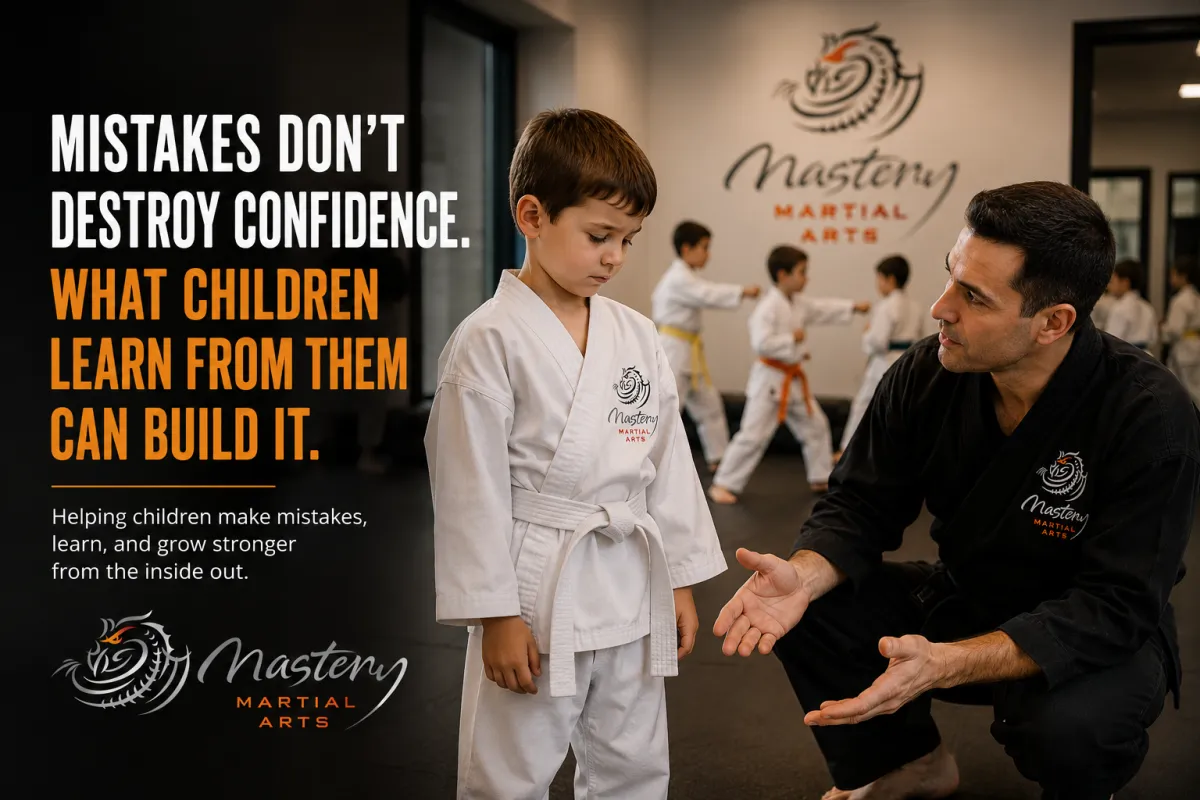
They try a new martial arts technique, turn the wrong direction, and suddenly look embarrassed.
Sometimes the reaction seems much bigger than the mistake.
And as a parent, you may wonder:
Why is my child so afraid of getting things wrong?
The answer may have very little to do with the mistake itself.
Your child may be worried about what the mistake means about them.
Quick Answer
Children can become afraid of making mistakes when they connect being wrong with embarrassment, disappointment, failure, or not being “good enough.” Parents can help by normalizing mistakes, separating performance from identity, praising recovery and effort, and giving children repeated opportunities to make mistakes, adjust, and try again.
Confidence does not come from getting everything right.
It grows when children discover:
“I can get something wrong and still be okay.”
Key Takeaways
Fear of mistakes is often connected to fear of judgment or failure.
Children may interpret mistakes as evidence about their ability or identity.
Constantly preventing mistakes can unintentionally make them feel more dangerous.
Confidence grows when children experience mistakes and recover from them.
Parents can praise adjustment, persistence, and courage instead of only correct outcomes.
Children need evidence that being wrong does not mean something is wrong with them.
What You’ll Learn
By the end of this article, you will understand:
Why some children become so uncomfortable with mistakes.
Why fear of mistakes can lead to avoidance and giving up.
The difference between a mistake and the meaning a child gives it.
How parents can respond without rescuing or minimizing.
What to say when your child gets something wrong.
How repeated mistakes can actually become part of building real confidence.
A Mistake Is an Event. Children Can Turn It Into an Identity.
A child misses a math problem.
That is an event.
But the child may think:
“I’m bad at math.”
A child misses the ball.
That is an event.
But the child may think:
“I’m terrible at soccer.”
A child forgets a martial arts technique.
That is an event.
But the child may think:
“Everyone else is better than me.”
Notice what happened.
The child moved from:
Something I did
to:
Something I am.
That distinction matters.
When children repeatedly connect mistakes with their identity, new challenges can begin to feel threatening.
Instead of thinking:
“Let me see if I can figure this out.”
They may begin thinking:
“What if this proves I’m not good at it?”
Eventually, the safest strategy can feel like not trying at all.
That is one reason some children become afraid to try new things.
The problem is not always the challenge.
Sometimes it is the meaning the child has learned to attach to struggling.
Why Are Some Children So Afraid of Making Mistakes?
There is rarely one single reason.
Children are constantly learning what success, failure, approval, and ability mean from the environments around them.
A child may become increasingly cautious when they begin worrying about:
disappointing a parent
being corrected in front of others
looking less capable than friends
receiving a poor grade
losing a game
being laughed at
needing help
not learning something quickly
failing to meet their own expectations
For some children, this creates a powerful internal rule:
If I cannot do it well, maybe I should not do it at all.
That rule can quietly limit a child's willingness to explore.
The Connection Between “I Can’t” and Fear of Mistakes
Sometimes the words“I can’t”really mean:
“I don't want to find out that I can't.”
That is an important difference.
If your child refuses to attempt something, they never have to experience being wrong.
Avoidance protects them temporarily.
But it also prevents them from collecting new evidence about what they are capable of doing.
This is why understanding why your child says “I can’t” matters.
The words may sound like a statement about ability.
Underneath them may be uncertainty:
“What happens if I try and it doesn't work?”
Confidence Is Not the Belief That You Won’t Make Mistakes
This is one of the most important distinctions we can teach children.
Confidence is not:
“I know I will get this right.”
A healthier form of confidence sounds more like:
“I don't know if I'll get it right, but I can try.”
Or:
“If I make a mistake, I can figure out what to do next.”
Or:
“I haven't learned this yet.”
That kind of confidence is more durable because it does not depend on perfect performance.
A child can fail a test.
Miss a kick.
Forget a line.
Lose a game.
Get corrected.
Start over.
And still maintain belief in themselves.
That is very different from confidence that only exists when everything is going well.
Confidence vs. Perfection

The goal is not to convince children that outcomes do not matter.
Learning matters.
Improvement matters.
Doing our best matters.
But children need to understand that performance provides information—it does not determine their worth.
Why Rescuing Children From Mistakes Can Backfire
Parents naturally want to help.
You see the forgotten homework sitting on the counter.
You bring it to school.
Your child struggles to answer a question.
You answer for them.
They are building something incorrectly.
You step in and fix it.
They are nervous about trying.
You tell them they do not have to.
Each decision can feel small.
And sometimes children genuinely do need help.
But when adults consistently prevent children from experiencing mistakes, frustration, or natural consequences, children can miss an important lesson:
“I can handle what happens when things don't go perfectly.”
We do not want children to struggle unnecessarily.
We also do not want to remove every opportunity for them to discover their own capability.
Support and rescue are not the same thing.
Support vs. Rescue

Sometimes the most confidence-building thing a parent can do is stay close enough to support while giving the child enough room to figure something out.
The Mastery Mistake-to-Confidence Cycle™
Mistakes do not automatically build confidence.
What happens after the mistake does.
Here is the cycle we want children to experience:
TRY
The child attempts something they cannot completely control.
↓
MISTAKE
Something does not go as planned.
↓
PAUSE
Instead of panicking or quitting, the child learns to regulate their response.
↓
LEARN
“What happened?”
↓
ADJUST
The child changes something.
↓
TRY AGAIN
They take another attempt.
↓
IMPROVEMENT
Maybe they get it.
Maybe they simply get closer.
↓
EVIDENCE
The child realizes:
“I made a mistake and figured out what to do next.”
↓
CONFIDENCE
That evidence becomes self-belief.
This is one of the reasons confidence comes from doing hard things.
Difficulty gives children an opportunity to discover something about themselves that easy success cannot always teach.
Mistakes Are Feedback
Imagine a child learning to kick.
The first kick misses the target.
What did we learn?
Maybe they were standing too far away.
They move closer.
The second kick hits the target but lacks balance.
What did we learn?
They need to adjust their stance.
The third attempt improves.
None of the first two attempts were wasted.
They contained information.
That is the meaning we want children to learn:
A mistake tells me something about what to do next.
Instead of:
Mistake = I'm bad at this
we want:
Mistake = information
Information = adjustment
Adjustment = improvement
Improvement = evidence
Evidence = confidence
What Parents Say After a Mistake Matters
Children listen closely to the adults around them.
Not only to our words.
They notice our faces.
Our tone.
Our frustration.
Our urgency.
Our disappointment.
When a child spills something and hears:
“What were you thinking?”
the emotional lesson can become bigger than the spill.
When they miss a shot and immediately hear five corrections from the sideline, the mistake can begin to feel dangerous.
This does not mean parents should never correct children.
Correction is essential to learning.
The question is:
What meaning accompanies the correction?

Five Ways to Help a Child Who Is Afraid of Making Mistakes
1. Normalize Being Wrong
Children need to know that mistakes are expected when learning.
You can say:
“Of course you don't know how to do it yet. You're learning.”
That single word—yet—leaves room for growth.
2. Tell Them About Your Own Mistakes
Children sometimes imagine adults simply know how to do everything.
Let them see appropriate examples of your own learning.
“I made a mistake at work today and had to fix it.”
Then tell them what you did next.
The important part is not the mistake.
It is the recovery.
3. Ask Learning Questions
Instead of immediately correcting, ask:
“What happened?”
“What did you notice?”
“What could you change?”
“What will you try next?”
These questions shift the child's attention away from judgment and toward problem-solving.
4. Praise the Recovery
Parents often praise the successful attempt.
Try noticing what happened immediately before it.
“You missed it, changed your position, and tried again.”
That statement gives the child evidence about their character.
The lesson becomes:
I am someone who can recover.
5. Give Them More Opportunities to Be Beginners
This may be the most overlooked strategy.
Children need experiences where they do not already know what to do.
Cook something new.
Learn a game.
Build something.
Try an instrument.
Join an activity.
Take a class.
Learn a physical skill.
The objective is not to make children uncomfortable for the sake of discomfort.
It is to give them manageable opportunities to experience:
New → Nervous → Try → Mistake → Adjust → Improve
The more familiar that sequence becomes, the less threatening being new can feel.
What If My Child Gets Very Upset After a Mistake?
Sometimes the first job is not teaching.
It is regulation.
A child who is overwhelmed may not be ready for a lesson about perseverance.
Help them settle.
Then return to what happened.
You might say:
“That was frustrating.”
Then:
“When you're ready, we'll figure out what to try next.”
Notice what we are not saying.
We are not saying:
“Stop being upset.”
And we are not saying:
“Never mind. You don't have to do it.”
The message is:
Your feeling is real—and you are still capable.
Learning to work through frustration is closely connected to learning how to persist when something becomes difficult.
Children who struggle with this may also begin giving up when things feel hard.
Why Being Corrected Can Feel So Personal
Some children hear:
“Move your foot.”
But emotionally interpret:
“You're doing badly.”
They hear:
“Try that again.”
But interpret:
“You failed.”
Learning to receive correction without turning it into a judgment about themselves is an important developmental skill.
We want children to gradually understand:
Correction is information.
Someone helping me improve is not someone telling me I am not good enough.
That distinction becomes increasingly important as children enter school, sports, leadership opportunities, relationships, and eventually the workplace.
The Goal Is Not to Raise a Child Who Never Fails
That child does not exist.
The goal is to raise a child who knows what to dowhen failure happens.
Imagine the difference.
Child A
Makes a mistake.
Feels embarrassed.
Avoids trying again.
Needs reassurance before continuing.
Child B
Makes a mistake.
Feels disappointed.
Pauses.
Listens.
Adjusts.
Tries again.
Both children experienced disappointment.
The difference is what they learned to do next.
That is resilience.
Why This Builds Real Confidence
Confidence becomes stronger when it has evidence underneath it.
Telling your child:
“You're amazing!”
may feel wonderful.
But imagine the power of your child being able to tell themselves:
“I was nervous and I tried.”
“I messed up and recovered.”
“I couldn't do it at first.”
“I kept practicing.”
“I figured it out.”
“I did it.”
Those are not compliments.
They are memories.
And memories become evidence.
When children accumulate enough evidence of themselves handling difficult situations, they begin to develop something even more important than temporary confidence:
self-trust.
How Martial Arts Can Help Children Become Comfortable With Mistakes
A martial arts class creates something valuable:
A controlled environment where children are expected to be learners.
A beginner walks into class without knowing:
How to stand.
How to kick.
How to punch.
Where to look.
How to move.
What the commands mean.
That is not a problem.
That is what being a beginner means.
A healthy martial arts environment does not expect children to already know the skill they came there to learn.
It gives them opportunities to practice.
Get corrected.
Try again.
Improve.
And eventually succeed.
At Mastery Martial Arts, we want children to understand:
Being new does not mean you're behind.
Being nervous does not mean stop.
A mistake does not mean you cannot do it.
Correction helps you improve.
Practice creates progress.
Effort creates evidence.
And evidence builds confidence.
The Belt Is Not Just a Reward
A belt can represent something much deeper than martial arts technique.
It can become physical evidence of accumulated effort.
A child remembers:
The technique they could not perform.
The day they became frustrated.
The correction they received.
The class where they wanted to quit.
The practice.
The improvement.
And eventually, the success.
The belt becomes evidence:
“I wasn't always able to do this.”
That matters.
Because the next time life presents something difficult, the child has a previous experience to draw from.
“I've struggled before.”
“I've learned before.”
“I've improved before.”
“Maybe I can figure this out too.”
That is how confidence begins moving toward self-trust.
Stronger From The Inside Out™
The visible achievement might be a better kick.
A stronger stance.
A new belt.
A board broken with a palm strike.
Those are things parents can see.
But the more important development may be happening where nobody can see it.
The child is learning:
I can be new.
I can be nervous.
I can be corrected.
I can make a mistake.
I can feel frustrated.
I can try again.
I can improve.
I can trust myself to figure things out.
That is what becomingStronger From The Inside Out™means.
A Simple Challenge for Parents This Week
Watch for one mistake your child makes.
Before correcting it immediately, give them a moment.
Then ask:
“What do you think happened?”
Follow with:
“What could you try next?”
And after they try again, notice something specific:
“You didn't get it the first time, but you changed what you were doing and tried again.”
You are doing more than helping them complete a task.
You are helping them build a new interpretation of mistakes.
Instead of:
“I failed.”
They begin learning:
“I found my next step.”
Frequently Asked Questions
Why is my child so afraid of making mistakes?
Some children connect mistakes with embarrassment, disappointing others, or believing they are not capable. Temperament, past experiences, expectations, and the child's environment can all influence how they interpret mistakes.
Is it normal for children to get upset when they make mistakes?
Yes. Disappointment and frustration are normal emotions. The important developmental skill is learning how to regulate those feelings and eventually return to the challenge.
Should I correct every mistake my child makes?
Not necessarily. Sometimes children benefit from time to notice and solve a problem independently. When correction is necessary, focus on what they can adjust rather than treating the mistake as a personal failure.
What should I say when my child makes a mistake?
Try questions such as“What did you notice?”,“What did that teach you?”, or“What could you try differently?”These encourage reflection rather than shame.
What if my child says, “I'm stupid”?
Separate the event from their identity. You might respond:“Getting something wrong doesn't mean you're stupid. It means you found something you're still learning.”
Can too much praise make children afraid of failure?
Praise can be helpful, but children also need feedback tied to specific behaviors they can control, such as effort, persistence, preparation, adjustment, and follow-through. This gives them useful information about how improvement happens.
How can I help my child stop being a perfectionist?
Avoid making perfection the standard. Normalize being a beginner, model your own mistakes, encourage experimentation, and recognize recovery and improvement rather than only flawless outcomes.
Why does my child quit when they cannot do something immediately?
They may interpret initial difficulty as evidence that they lack ability. Helping them understand that competence develops through practice can change the meaning of early struggle.
How do mistakes build confidence?
Mistakes become confidence-building experiences when children learn from them, adjust, try again, and experience improvement. The recovery provides evidence that they can handle difficulty.
Can martial arts help a child who is afraid of failure?
A supportive martial arts environment can provide repeated opportunities to be a beginner, receive feedback, practice skills, experience setbacks, and see measurable improvement. Those experiences can help children develop persistence and self-trust.
Continue Learning
If this article describes your child, continue with:
Why Some Children Are Afraid to Try New Things—and How to Help Them Begin
Then read:
Why Your Child Says “I Can't” (Even When They Probably Can)
And:
Why Some Children Give Up So Easily
For the deeper principle behind all three:
Why Confidence Comes From Doing Hard Things
Together, these articles explain an important pattern:
Being New → Nervousness → Trying → Mistakes → Recovery → Evidence → Confidence → Self-Trust
About Mastery Martial Arts
Mastery Martial Arts has been helping children develop confidence, focus, discipline, resilience, and leadership since 1993.
We believe martial arts can be much more than learning kicks and punches.
It can provide children with structured experiences that teach them how to listen, focus, practice, respond to correction, work through frustration, set goals, and discover what they are capable of doing.
Every child begins somewhere.
Every child makes mistakes.
Every child experiences moments when something feels difficult.
Those moments are not interruptions to confidence development.
They are where confidence can begin.
Because eventually, the child who once thought:
“What if I get it wrong?”
can begin thinking:
“If I get it wrong, I'll figure out what to do next.”
And that may be one of the most valuable forms of confidence we can help a child develop.
Stronger From The Inside Out™
