Why Kids Are Afraid to Try New Things | How Parents Can Help
Why Some Children Are Afraid to Try New Things—and How to Help Them Begin
Every parent has seen the moment.
Your child stands at the edge of the soccer field but will not join the other children.
They arrive at a birthday party and suddenly hide behind your leg.
They watch another child participate in an activity they seemed excited about five minutes earlier.
Then come the words:
“I don’t want to.”
It can look like stubbornness.
It can feel like a lack of motivation.
But many times, your child is quietly wondering:
“What if I can’t do it?”
“What if everyone watches me?”
“What if I make a mistake?”
Your child may not be refusing the activity.
They may be trying to protect themselves from the uncomfortable feeling of being new.

Quick Answer
Children are often afraid to try new things because unfamiliar experiences create uncertainty, self-consciousness, and fear of making mistakes. Parents can help by normalizing nervousness, breaking the experience into smaller steps, praising courage rather than performance, and giving children repeated opportunities to discover that they can handle discomfort.
Key Takeaways
Being nervous about something new is normal.
Avoidance is often self-protection, not laziness.
Confidence usually develops after children take action.
Allowing children to escape every uncomfortable situation can strengthen avoidance.
Small, supported challenges help children build courage.
Repeated experiences of “I did it” create lasting self-belief.

Why New Experiences Feel So Big to Children
Adults sometimes forget what it feels like to be completely new.
We have already experienced hundreds of first days, unfamiliar rooms, introductions, mistakes, and awkward beginnings.
Children have not.
A new activity may involve:
People they have never met
Rules they do not understand
Skills they have not practiced
The possibility of being watched
The risk of making a mistake
Uncertainty about what will happen next
To an adult, walking into a new class may seem simple.
To a child, it can feel like stepping into a room where everyone else already knows what to do.
Their brain begins asking:
Am I safe here?
Will I fit in?
What happens if I get it wrong?
When children cannot answer those questions, staying close to a parent or refusing to participate can feel like the safest choice.
Avoidance is not always a sign that a child is incapable.
Sometimes it is simply how they respond to uncertainty.
Children who repeatedly avoid difficult or unfamiliar experiences may also begin giving up more easily when something feels hard.

Confidence Usually Comes After Action
Many adults believe children need confidence before they can begin.
But confidence rarely works that way.
Think about a child learning to ride a bicycle.
They do not become confident and then climb onto the bike.
They climb onto the bike while they are still uncertain.
They wobble.
They put their feet down.
They try again.
Eventually, they travel a few feet without help.
That successful experience becomes evidence:
“Maybe I can do this.”
The confidence comes after the action.
The same pattern happens when children:
Enter a new classroom
Raise their hand
Introduce themselves
Join a team
Perform in front of others
Attempt a difficult skill
Walk into their first martial arts class
Children become more confident when they collect real experiences that show them they are capable.
This is why confidence often comes from doing hard things—not from waiting until fear disappears.
Your Child May Not Be Afraid of the Activity
Sometimes children are not afraid of the activity itself.
They are afraid of what the activity might reveal about them.
They may wonder:
“What if everyone else is better than me?”
“What if I look silly?”
“What if the teacher corrects me?”
“What if Mom and Dad are disappointed?”
The child who refuses to play soccer may not dislike soccer.
They may be worried about missing the ball.
The child who will not speak in front of the class may know the answer.
They may be worried about saying it incorrectly.
The child who resists martial arts may actually want to participate.
They may simply be uncomfortable wearing a uniform, entering a new room, or not knowing what comes next.
This is especially common in thoughtful children who notice details, compare themselves to others, or hold themselves to very high standards. Some highly capable children quietly struggle with self-doubt and fear of not performing perfectly.
The behavior parents see is refusal.
The feeling underneath it may be vulnerability.
When Helping Accidentally Strengthens Avoidance
Parents naturally want to protect their children.
When a child looks overwhelmed, it is tempting to say:
“You don’t have to do it.”
Sometimes leaving is the right decision.
But when children are allowed to escape every situation that makes them nervous, they can begin learning:
“When something feels uncomfortable, I should avoid it.”
The relief they feel after escaping reinforces the behavior.
The next unfamiliar situation may feel even bigger.
Over time, the child’s world can gradually become smaller.
They may avoid:
New activities
New friendships
Speaking in groups
Difficult schoolwork
Competition
Opportunities that involve risk
Situations where they may not succeed immediately
Protecting children from every difficult feeling can unintentionally prevent them from discovering how capable they really are.
Children need support, but they also need manageable opportunities to struggle, adapt, and grow. That is why children need to experience challenges instead of having every obstacle removed.
The goal is not to force children into overwhelming situations.
The goal is to help them take one reasonable step beyond what currently feels comfortable.
Five Ways to Help Your Child Try Something New
1. Normalize the Nervous Feeling
Children may interpret nervousness as a warning that they should stop.
Help them understand that nervousness often appears whenever people do something unfamiliar.
You might say:
“It makes sense that you feel nervous. You have never done this before.”
Or:
“Being nervous does not mean you cannot do it. It means this is new.”
This separates the feeling from the decision.
Your child can feel nervous and still move forward.
That is courage.
2. Make the First Step Smaller
Children often picture the entire experience at once.
They imagine the full class.
The whole game.
The complete performance.
Every person who might watch.
That can feel overwhelming.
Instead, shrink the challenge.
The first goal may be:
Put on the uniform
Walk into the building
Meet the instructor
Watch the class
Stand with the group
Participate for five minutes
Try one skill
Small steps reduce uncertainty and create forward movement.
A child does not need to conquer the entire experience today.
They only need to take the next step.
3. Praise Courage Instead of Performance
When children try something new, adults sometimes focus immediately on the outcome.
“Did you win?”
“Were you the best one?”
“Did you get it right?”
Those questions can make children believe that trying only matters when it produces success.
Instead, recognize what they controlled:
“I noticed that you walked in even though you felt nervous.”
“You stayed with it when it became difficult.”
“You tried something you had never done before.”
“I’m proud of the way you kept going.”
This teaches children that courage, effort, and perseverance matter.
It also helps them understand that mistakes do not make the experience a failure.
4. Do Not Rescue Too Quickly
There is an important difference between supporting a child and completing the challenge for them.
Support sounds like:
“I’m right here.”
“Take your time.”
“What is one part you can do yourself?”
“Let’s figure out the next step.”
Rescuing may look like:
Answering for them
Completing the task
Removing the challenge immediately
Speaking to every adult on their behalf
Allowing them to quit before they have had time to adjust
When adults solve every problem, children receive short-term relief.
But they lose the chance to experience:
“I handled that.”
Helping children believe in themselves requires giving them appropriate opportunities to discover their own ability.
5. Celebrate the Small Win
A child may not complete the entire activity on the first day.
That does not mean the day was unsuccessful.
Maybe they walked through the door.
Maybe they introduced themselves.
Maybe they stood with the group.
Maybe they attempted one skill.
Maybe they stayed five minutes longer than they expected.
Notice that progress.
You might say:
“Yesterday you did not want to walk inside. Today you walked in and met the instructor.”
That creates evidence of growth.
Small wins matter because children build confidence by remembering what they have already overcome.
One successful moment becomes something they can carry into the next challenge.
The Power of Someone Who Believes in Them
Children often borrow belief before they fully own it.
They look at the adults around them and ask, without saying the words:
“Do you think I can handle this?”
A calm parent communicates:
“I know this feels difficult, and I believe you can take the next step.”
A patient teacher communicates:
“You do not need to know everything yet. I will help you learn.”
An encouraging coach communicates:
“Mistakes belong here. Keep going.”
Children begin seeing themselves through the eyes of trusted adults.
Over time, borrowed belief becomes self-belief.
That is why children need someone who believes in them long enough for them to begin believing in themselves.
How Mastery Martial Arts Helps Children Begin
Every child who enters Mastery Martial Arts experiences something unfamiliar.
A new instructor.
New classmates.
A new uniform.
New movements.
New expectations.
Some children walk onto the floor immediately.
Others hold a parent’s hand.
Some speak softly.
Some watch before participating.
Some need a little more time.
That is okay.
At Mastery, confidence is not expected on the first day.
It is developed through the experience.
Our instructors help children understand:
Being new is normal
Mistakes are expected
Effort is celebrated
Skills improve through repetition
Nervousness does not mean they should quit
Every child can take the next step
Children are given structured challenges with clear instruction, positive encouragement, and attainable goals.
They learn one movement.
Then another.
They practice.
They receive feedback.
They improve.
They earn a stripe.
They demonstrate a skill.
They hear their classmates cheer.
Each moment becomes evidence:
“I did it.”
That is how martial arts can help children develop confidence, focus, and emotional strength.
What Begins in Class Can Follow Children Everywhere
The deeper value is not simply that a child learns a martial arts technique.
It is what that experience teaches them about themselves.
The child who walks into class despite feeling nervous learns:
“I can begin before I feel completely ready.”
The child who makes a mistake and tries again learns:
“Getting something wrong does not mean I should stop.”
The child who performs in front of classmates learns:
“I can be seen without hiding.”
The child who earns a stripe learns:
“My effort creates progress.”
Those lessons can follow children into:
School
Friendships
Sports
Public speaking
Homework
New environments
Future opportunities
A child who learns to take action despite nervousness is better prepared to meet life instead of retreating from it.
A Note for Parents of Shy or Quiet Children
Not every quiet child needs to become loud.
A child does not need to become the most outgoing person in the room to be confident.
Real confidence may look like:
Making eye contact
Speaking clearly when needed
Joining an activity at their own pace
Asking for help
Introducing themselves
Expressing an opinion
Standing up for what is right
Trying something even when they feel uncertain
The goal is not to change your child’s personality.
The goal is to help them trust themselves.
Quiet children can become strong leaders.
Thoughtful children can become courageous communicators.
Reserved children can learn to participate without pretending to be someone else.
Parents looking for additional support may also find value in our guide on how to help a shy child build confidence.
From “I Don’t Want To” to “Let Me Try”
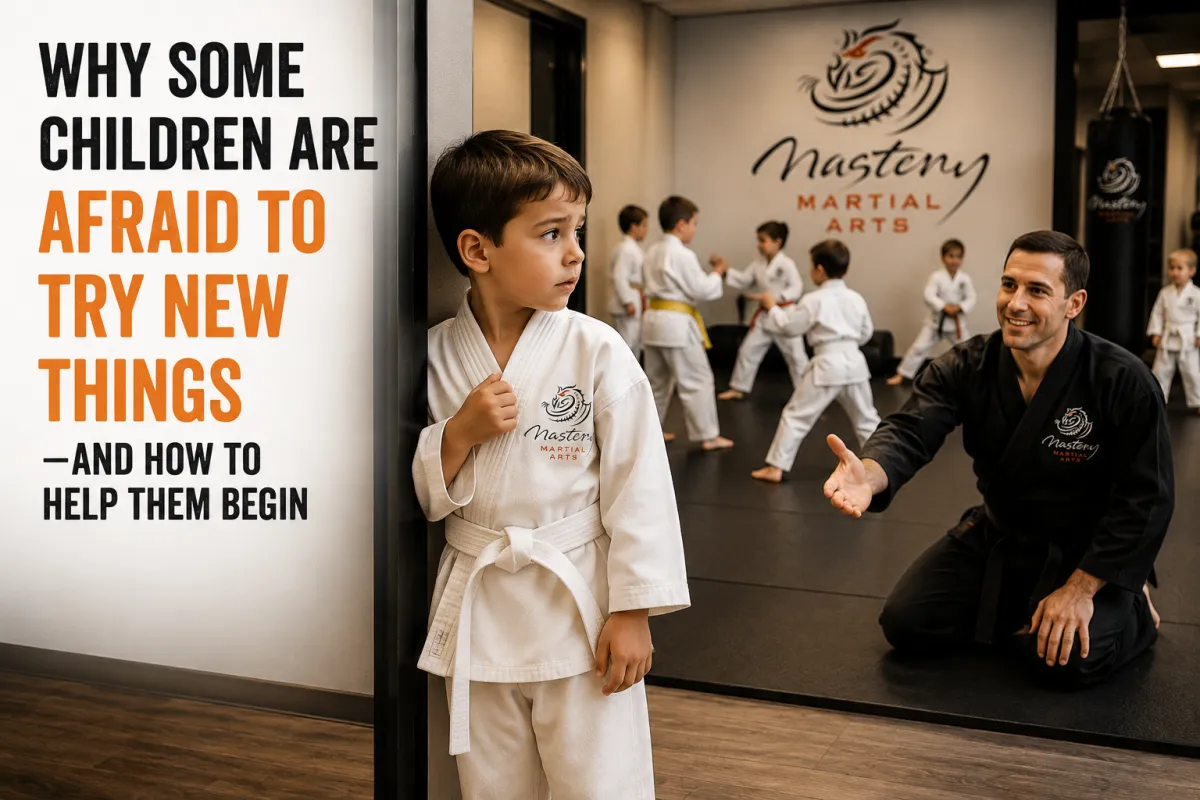
Imagine your child standing outside a new class.
They grip your hand.
They tell you they do not want to go inside.
You kneel beside them and say:
“You do not have to know how to do everything today.”
“You only have to take the first step.”
They walk through the door.
They watch.
Then they participate.
Maybe only for a few minutes.
When class ends, they look up and say:
“Can we come back?”
That is how confidence begins.
Not with the absence of fear.
With a child discovering they can move while fear is still present.
Final Thoughts
Every confident adult was once a child facing something unfamiliar.
Confidence was not handed to them.
It was built through moments when they:
Felt nervous
Took a step
Made a mistake
Tried again
Discovered they were capable
Your child does not need every fear removed.
They need loving adults who help them understand that fear does not get to make every decision.
They need experiences that allow them to say:
“I was nervous, but I did it.”
One first step.
One small victory.
One new experience at a time.
That is how children become stronger from the inside out.
Help Your Child Take the First Step
At Mastery Martial Arts, we have spent more than 30 years helping children build confidence, focus, discipline, leadership, resilience, and courage through age-appropriate martial arts training.
Your child does not need to arrive confident.
They only need a safe place to begin.
During their Free Mastery Introductory Lesson, they will meet an instructor, experience the environment, try a few skills, and discover that being new is completely normal.
Schedule Your Child’s Free Mastery Introductory Lesson
Find a Mastery Martial Arts Location Near You
Continue Reading
Why Some Children Give Up So Easily—and How to Help Them Keep Going
How Martial Arts Builds Confidence, Focus, and Emotional Strength
About Mastery Martial Arts
Since 1993, Mastery Martial Arts has helped children throughout Rhode Island and Massachusetts build confidence, focus, discipline, leadership, resilience, and communication skills.
Our age-appropriate programs use martial arts as a vehicle for child development—giving children structured challenges, positive role models, supportive peer experiences, and repeated opportunities to succeed.
Our mission is simple:
Helping Kids Become Confident Leaders for Life.
Mastery Martial Arts—Stronger From The Inside Out™.
