
Why Kids Lose Confidence as They Get Older: A Parent's Guide
WHY KIDS LOSE CONFIDENCE AS THEY GET OLDER
Most children are not born with self-doubt.
In fact, if you've ever watched a four-year-old sing loudly, dance in public, or confidently introduce themselves to a complete stranger, you've seen what confidence naturally looks like.
Young children rarely worry about being judged.
They don't spend much time wondering if they're good enough.
They simply try.
Then something changes.
As children get older, many begin questioning themselves more often. They become hesitant. They stop raising their hand. They avoid trying new things. They become more concerned about what other people think.
Parents often notice the change and ask:
"What happened to my confident child?"
The answer is rarely one thing.
Confidence usually doesn't disappear overnight.
It fades gradually through experiences, comparisons, failures, and the stories children begin telling themselves about who they are.
The good news?
Confidence can be rebuilt.
But first, it helps to understand why children lose it in the first place.
CHILDREN ARE NOT BORN WITH SELF-DOUBT
Confidence is a child's natural starting point.
Most young children are willing to:
Try new things
Ask questions
Make mistakes
Learn through trial and error
Express themselves freely
They don't see mistakes as evidence that something is wrong with them.
They see mistakes as part of learning.
A toddler can fall a hundred times while learning to walk and still get back up.
They don't sit there thinking:
"Maybe walking just isn't for me."
But as children grow, they become increasingly aware of how they compare to other people.
This awareness changes everything.
THE MOMENT COMPARISON BEGINS

One of the biggest confidence killers is comparison.
At some point children begin noticing:
Who runs faster.
Who reads better.
Who gets more attention.
Who has more friends.
Who gets picked first.
Who seems more successful.
Comparison shifts a child's focus away from growth and toward status.
Instead of asking:
"Am I improving?"
They begin asking:
"Am I as good as everyone else?"
The problem is there will always be someone faster.
Smarter.
More talented.
More experienced.
When children constantly compare themselves to others, confidence often suffers.
Because someone else's strengths start becoming evidence of their weaknesses.
HOW SCHOOL CAN SLOWLY ERODE CONFIDENCE

School can be an incredible confidence builder.
It can also become a place where confidence slowly fades.
Children spend thousands of hours in school while their identity is developing.
Every day they receive feedback through:
Grades
Tests
Teacher comments
Social interactions
Athletic performance
Many children begin attaching their self-worth to these outcomes.
A bad test becomes:
"I'm not smart."
A missed shot becomes:
"I'm not athletic."
A social rejection becomes:
"No one likes me."
Over time, repeated negative experiences can create a belief system that follows children long after the original event.
The problem isn't the event itself.
It's the meaning children attach to the event.
SOCIAL MEDIA AND THE CONFIDENCE CRISIS
Today's children face a challenge previous generations never experienced.
Constant comparison through social media.
Social media rarely shows reality.
It shows highlight reels.
Children see:
Perfect photos
Perfect vacations
Perfect friendships
Perfect achievements
What they don't see are the struggles behind those moments.
Many children begin believing everyone else is happier, more successful, and more confident than they are.
This creates a dangerous illusion.
The illusion that everyone else has it figured out.
When children believe that, self-doubt often follows.
THE FEAR OF FAILURE TRAP

Many children don't lose confidence because they fail.
They lose confidence because they become afraid of failing.
The fear of failure creates avoidance.
Children stop trying things they might not immediately succeed at.
They avoid challenges.
They stay in their comfort zone.
Unfortunately, confidence is built outside the comfort zone.
Every confident person has a history of failing.
What separates confident children from unconfident children is not success.
It's their relationship with failure.
Confident children eventually learn:
Failure is feedback.
Failure is part of growth.
Failure is not identity.
This is one reason we often tell students:
Failure is my friend.
Because failure teaches lessons success never can.
7 SIGNS YOUR CHILD IS LOSING CONFIDENCE
Parents often miss the early warning signs.
Here are some of the most common:
1. They Avoid New Things
Trying feels risky.
So they stop trying.
2. They Give Up Quickly
Challenges feel like proof they can't do it.
3. Negative Self-Talk Increases
Statements like:
"I'm stupid."
"I'm bad at this."
"I can't do anything right."
Should never be ignored.
4. They Fear Making Mistakes
Perfectionism often hides low confidence.
5. They Stop Participating
The confident child who once volunteered becomes quiet.
6. They Compare Themselves Constantly
Their focus shifts from growth to ranking.
7. They Need Constant Reassurance
External validation replaces internal belief.
If you'd like a deeper look at confidence development, read our guide:
How to Build Confidence in Kids:
https://masteryma.com/post/how-to-build-confidence-in-kids
HOW PARENTS ACCIDENTALLY CONTRIBUTE TO LOW CONFIDENCE
Every parent wants their child to feel confident.
Sometimes our best intentions create unintended consequences.
Solving Every Problem
Children never discover what they're capable of if adults always step in.
Overprotecting From Failure
Children need manageable challenges.
Not a challenge-free life.
Constant Correction
If children only hear what's wrong, they begin believing something is wrong with them.
Comparison
Nothing destroys confidence faster than comparing children to siblings, classmates, or friends.
Confidence grows when children measure progress against themselves.
Not against everyone else.
HOW CONFIDENCE CAN BE REBUILT
What One Parent Experienced

One East Greenwich parent shared:
"For the last 3 1/2 years I've watched my two shy, anxious littles grow into 2 outgoing, adventurous, VERY talkative and engaging kids. All done with the positive, energetic and contagious YES I CAN ATTITUDE!!!!"
— Paul Black, Mastery Martial Arts East Greenwich Parent
Read the full review:
https://maps.app.goo.gl/44ngjF3SorC6g9YV7
Many children who struggle with confidence are not lacking ability.
They are lacking belief.
When children begin collecting evidence that they can overcome challenges, speak up, try new things, and succeed, confidence often returns faster than parents expect.
The encouraging news is confidence is not fixed.
It can be rebuilt.
Children rebuild confidence by collecting new evidence.
Evidence that they can:
Learn
Improve
Grow
Overcome challenges
Every small win matters.
Every challenge overcome matters.
Every success becomes proof.
And proof becomes belief.
Confidence is not something children think their way into.
It's something they experience their way into.
WHY MARTIAL ARTS HELPS CHILDREN REBUILD CONFIDENCE
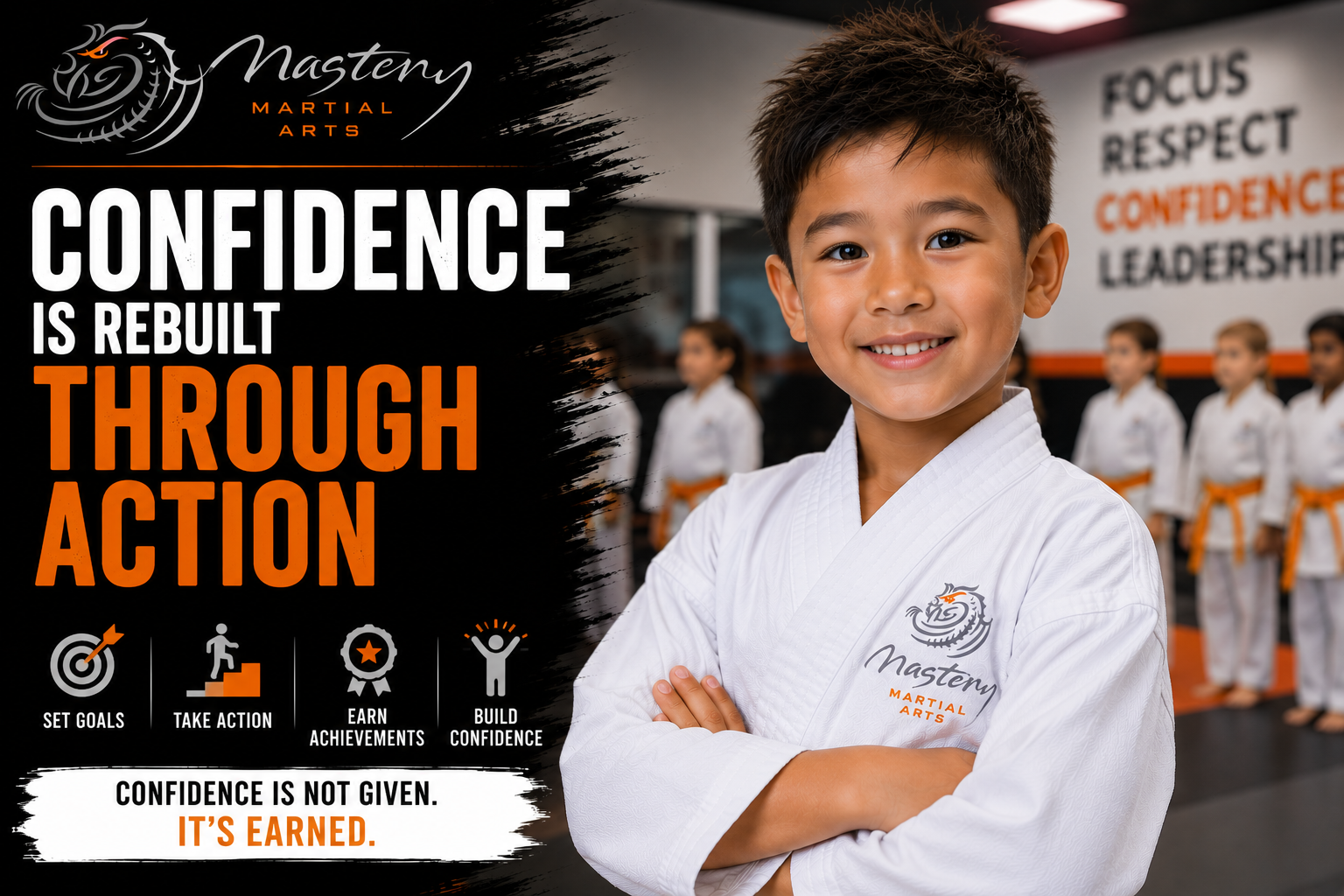
Martial arts creates a structured environment where children experience:
Challenge
Progress
Achievement
Leadership
Encouragement
Children learn new skills.
They overcome obstacles.
They earn recognition.
They discover they can do things they once believed were impossible.
Over time they stop seeing themselves as someone who lacks confidence.
They begin seeing themselves as someone who is capable.
That shift changes everything.
It changes how they think.
How they act.
How they respond to challenges.
And ultimately how they see themselves.
FINAL THOUGHT
Children are not born doubting themselves.
Self-doubt is learned.
Which means confidence can be learned too.
The goal isn't to help children avoid every challenge.
The goal is to help them face challenges and discover they are stronger than they realized.
Because confidence isn't built by making life easier.
Confidence is built when children learn they can handle hard things.
RELATED CONFIDENCE RESOURCES
Why Kids Lose Confidence As They Get Older
How to Build Confidence in Kids
Why Kids With Low Confidence Become Quiet
How Bullying Impacts Confidence
How to Help Your Child Believe In Themselves
