How to Build Confidence in Kids: The Parent's Complete Guide
THE PARENT'S COMPLETE GUIDE TO BUILDING CONFIDENCE IN KIDS
How to Build Confidence in Kids: The Skills, Experiences, and Mindsets That Help Children Believe in Themselves
Most parents want the same thing for their child.
They want them to believe in themselves. To try new things without freezing. To make friends, handle setbacks, speak up, and stand up without falling apart.
In other words:
They want their child to be confident.
But confidence is one of the most misunderstood traits in child development.
Most people treat it like a personality trait—something you're born with. Something you either have or don't have.
That's not how confidence works.
Confidence is a skill.
And like every skill, it can be built.
Every child can develop confidence when they are given the right experiences, support, and opportunities to grow.
This guide covers everything parents need to know about confidence:
What confidence actually is
Why children lose it
How it changes at different ages
How it can be rebuilt
What parents can do to help
Whether your child is four or fourteen, struggling quietly or visibly, this is the place to start.
WHAT CONFIDENCE ACTUALLY IS
Confidence is not the absence of fear.
Confident children still feel nervous.
They still experience uncertainty.
They still make mistakes.
They still fail.
The difference is they move forward anyway.
Confidence is trust.
Trust that says:
"I can handle this."
Not because success is guaranteed.
But because they have enough evidence from previous experiences to believe they can figure things out.
Confidence is earned trust in yourself.
And it grows every time a child attempts something difficult and comes out the other side.
Many parents unintentionally wait for confidence to appear before encouraging action.
But confidence rarely comes first.
Action comes first.
Confidence follows evidence.
A child who tries a new skill and struggles, then improves, has just added evidence to their growing belief system:
"I am the kind of person who can figure things out."
That belief, accumulated over hundreds of experiences, becomes confidence.
WHY CONFIDENCE MATTERS MORE THAN MOST PARENTS REALIZE
Confidence affects nearly every area of a child's life.
Children with healthy confidence are more likely to:
Participate in class
Try new activities
Communicate clearly
Make friends
Resist peer pressure
Handle setbacks
Step into leadership opportunities
Confidence becomes the foundation that supports:
Resilience
Emotional regulation
Communication
Independence
Leadership
Without confidence, children often get trapped by self-doubt.
And self-doubt quietly limits potential.
Not through one dramatic event.
But through all the opportunities they stop pursuing.
Confidence is not a luxury.
It is a foundation.
THE HIDDEN CONFIDENCE CRISIS FACING KIDS TODAY
Today's children face a very different world than previous generations.
They live in a world of:
Constant comparison
Social media
Academic pressure
Performance anxiety
Social dynamics that never fully turn off
Children are constantly asking themselves:
Am I good enough?
Am I smart enough?
Do people like me?
What if I fail?
What if I embarrass myself?
Rates of childhood anxiety and low self-worth continue to rise.
Many children struggle with confidence long before parents notice.
By the time a child is avoiding challenges or saying:
"I can't do anything right"
the confidence problem has often existed for months or years.
WHY KIDS LOSE CONFIDENCE AS THEY GET OLDER

One of the most common questions parents ask is:
"My child used to be confident. What happened?"
Children rarely lose confidence overnight.
It disappears gradually.
Confidence is often eroded by:
Comparison
Failure
Social pressure
Negative experiences
The stories children tell themselves
At age four, most children are fearless.
They sing.
They dance.
They try things.
They don't worry about looking foolish.
Then life introduces:
School
Grades
Competition
Social groups
Comparison
Children begin measuring themselves against others.
And if they repeatedly interpret those comparisons negatively, confidence begins to fade.
The biggest danger is not failure itself.
The biggest danger is the story children create about failure.
Instead of:
"I made a mistake."
They begin believing:
"I am the mistake."
Instead of:
"That was hard."
They begin believing:
"I'm not capable."
This is where confidence begins to erode.
CONFIDENCE AT EVERY AGE: WHAT TO EXPECT
Ages 3–6
Children are naturally exploratory and fearless.
Low confidence may appear as:
Excessive clinginess
Fear of trying new things
Extreme fear of mistakes
Ages 7–9
Comparison begins.
Children start noticing:
Who runs faster
Who gets more attention
Who seems more successful
Watch for:
Increased self-criticism
Withdrawal
Avoidance of challenges
Ages 10–12
Identity begins forming.
Children start deciding:
Who they are
What they're good at
What they're not
This is one of the most important confidence-building windows.
Ages 13+
Social comparison intensifies.
Confidence becomes deeply connected to:
Identity
Social belonging
Self-image
Teen confidence requires opportunities for genuine achievement and responsibility.
7 SIGNS YOUR CHILD IS LOSING CONFIDENCE
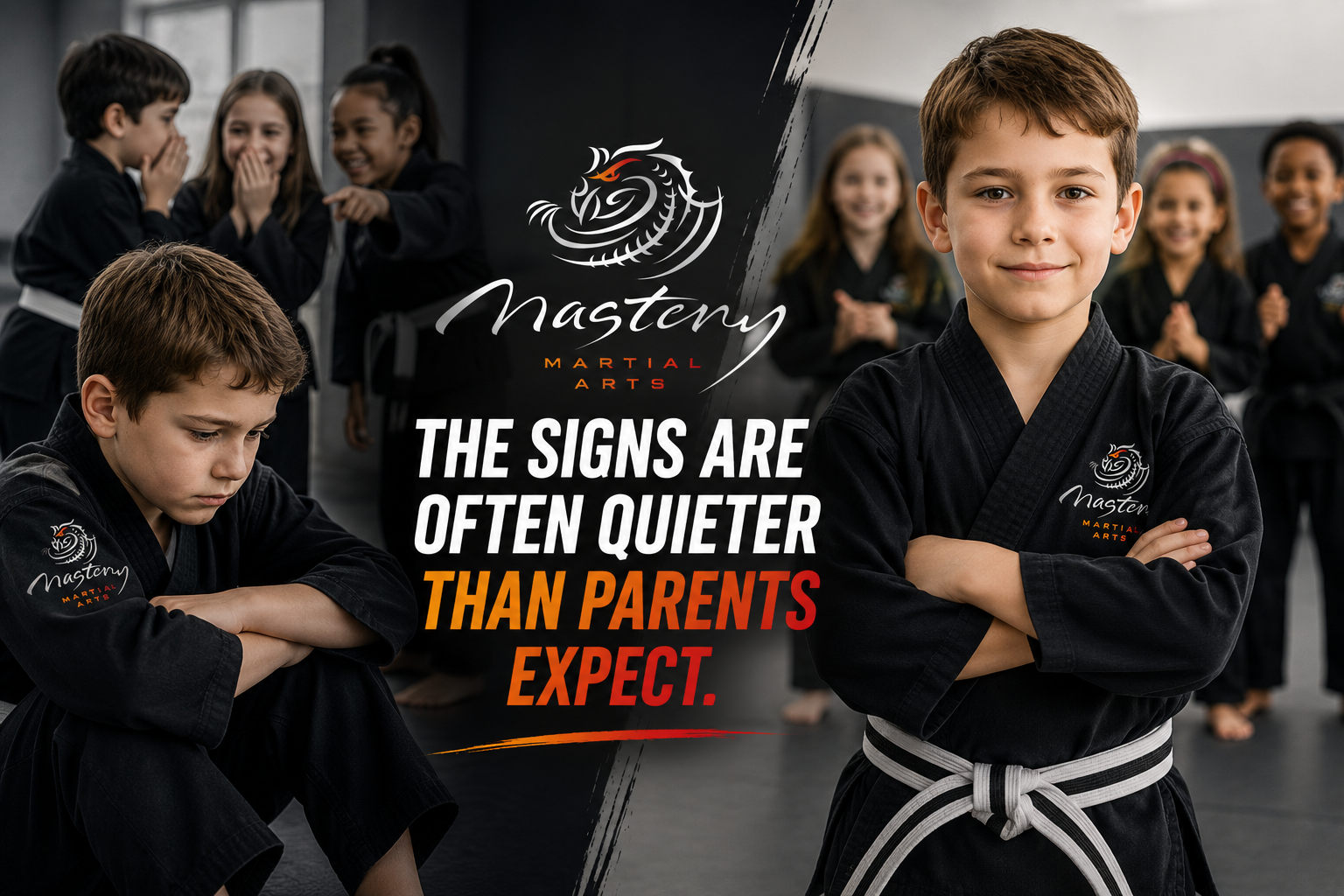
1. They Avoid New Things
Confidence grows through challenge.
Children losing confidence often avoid challenge.
2. They Give Up Quickly
Instead of pushing through discomfort, they stop.
3. Negative Self-Talk Increases
Statements like:
"I'm stupid."
"I can't do this."
"I'm bad at everything."
should never be ignored.
4. They Fear Making Mistakes
Perfectionism often hides low confidence.
5. They Stop Participating
The child who once raised their hand becomes quiet.
6. They Constantly Compare Themselves
Comparison slowly destroys confidence.
7. They Need Constant Reassurance
External validation replaces internal belief.
HOW SCHOOL CAN IMPACT YOUR CHILD'S CONFIDENCE
School can build confidence.
It can also damage it.
Children spend thousands of hours in school environments while their identities are forming.
The structure of school creates:
Evaluation
Comparison
Competition
Social hierarchy
Some children thrive.
Others begin quietly believing:
"I'm not smart enough."
"I'm not athletic enough."
"I'm not popular enough."
Teachers matter.
Peers matter.
The social environment matters.
The stories children build from those experiences matter most.
WHY SMART KIDS OFTEN STRUGGLE WITH CONFIDENCE

One of the biggest surprises for parents:
Intelligence and confidence are not the same thing.
In fact, some of the smartest children struggle with confidence the most.
Why?
Because many intelligent children become accustomed to easy success.
Then eventually they encounter something difficult.
For the first time they experience:
Frustration
Confusion
Failure
Uncertainty
And many don't know how to respond.
Instead of thinking:
"This is challenging."
They begin thinking:
"Maybe I'm not as smart as everyone thought."
They stop taking risks.
They become perfectionists.
They avoid challenge.
The irony:
Intelligence does not create confidence.
Struggle successfully overcome creates confidence.
CONFIDENCE VS. SELF-ESTEEM: WHAT'S THE DIFFERENCE?
These are not the same thing.
Confidence is:
"I believe I can do this."
Self-esteem is:
"I believe I have value."
Children need both.
Confidence develops through competence.
Self-esteem develops through connection and belonging.
A child can be highly confident and have low self-esteem.
A child can have healthy self-esteem and low confidence.
Strong child development builds both simultaneously.
HOW CONFIDENCE IS ACTUALLY BUILT
This is where most parents get stuck.
Confidence is not built by praise alone.
It is not built by telling children they are:
Smart
Special
Talented
Amazing
Those words can support confidence.
But they cannot create it.
Confidence is built through evidence.
A child gains confidence when they:
Attempt something difficult
Struggle
Persist
Improve
Succeed
Each experience becomes proof.
Proof creates belief.
Belief creates confidence.
The formula looks like this:
Challenge → Effort → Progress → Belief → Confidence
Most people think confidence comes before action.
It doesn't.
Action comes first.
Confidence follows.
WHY SMALL WINS BUILD BIG CONFIDENCE
Small wins are not small.
They are the building blocks of confidence.
Every stripe earned.
Every skill learned.
Every challenge overcome.
Every improvement noticed.
Adds another piece of evidence.
Children begin collecting proof that they are capable.
Eventually they stop saying:
"I hope I can."
And start believing:
"I know I can."
This is why structured progress matters.
Visible progress creates visible proof.
And visible proof creates confidence.
WHY FAILURE IS ACTUALLY GOOD FOR CONFIDENCE
Many parents try to protect their children from failure.
It comes from love.
But sometimes it creates the opposite result.
Confidence grows not despite failure.
Confidence grows because children learn they can recover from failure.
When children fail and try again they learn:
I can survive failure.
I can improve.
I can figure things out.
I can keep going.
Those lessons create resilience.
And resilience makes confidence durable.
Children protected from all failure often develop fragile confidence.
Children who learn to recover from failure develop lasting confidence.
Failure is not the enemy.
Avoiding challenge is.
BUILDING REAL CONFIDENCE VS. TEMPORARY CONFIDENCE
There are two types of confidence.
Temporary Confidence
Temporary confidence depends on:
Praise
Validation
Approval
Winning
It disappears when circumstances change.
Real Confidence
Real confidence comes from evidence.
Children with real confidence know:
"I've done hard things before."
"I've figured things out before."
"I can do it again."
This confidence survives setbacks.
Because it is built on experience.
Not emotion.
THE HIDDEN CONFIDENCE CRISIS OF COMPARISON
Many confidence problems are actually comparison problems.
Children compare themselves constantly.
They compare:
Grades
Friends
Sports ability
Appearance
Popularity
Comparison creates a dangerous story:
Everyone else is ahead.
Everyone else has it figured out.
I'm falling behind.
The solution is helping children shift from comparison to growth.
Instead of asking:
"Am I better than them?"
Children learn to ask:
"Am I improving?"
Growth-focused children develop stronger confidence because progress is always available.
Comparison-focused children rarely feel successful because someone always appears ahead.
HOW PARENTS ACCIDENTALLY HURT THEIR CHILD'S CONFIDENCE
Almost always with good intentions.
Rescuing Too Quickly
Children never discover what they're capable of when parents solve every problem.
Over-Praising
Praise without effort can create dependence on approval.
Constant Correction
Children begin focusing only on what they're doing wrong.
Comparison
Nothing destroys confidence faster than comparing a child to siblings or peers.
Low Expectations
Children eventually believe what adults repeatedly communicate about them.
The goal is not perfection.
The goal is creating an environment where children believe growth is possible.
CONFIDENCE ACTIVITIES FOR QUIET CHILDREN
Many parents ask:
"My child is shy. How do I help them become confident?"
The answer is important:
Confidence and personality are not the same thing.
A child can be:
Quiet
Thoughtful
Reserved
Introverted
And still be highly confident.
The goal is not to make a quiet child loud.
The goal is to help them trust themselves.
Effective confidence-building activities for quiet children include:
Small leadership opportunities
Goal setting
Teaching younger children
Martial arts
Public speaking in safe environments
Structured skill development
Many quiet children eventually become exceptional leaders because their confidence is deeply earned.
What One Barrington Parent Experienced
One Barrington parent shared:
"I cannot say enough great things about Mastery. Before Mastery my son was so shy and timid and now he has so much self confidence in himself."
— Ashley Russo, Mastery Martial Arts Barrington Parent
Read the full review:
https://maps.app.goo.gl/vsPcu74Kuq4cksQ27
This is a reminder that confidence doesn't require a child to become loud.
It helps a child become more comfortable being themselves.
CONFIDENCE, BULLYING, AND THE COURAGE TO STAND UP
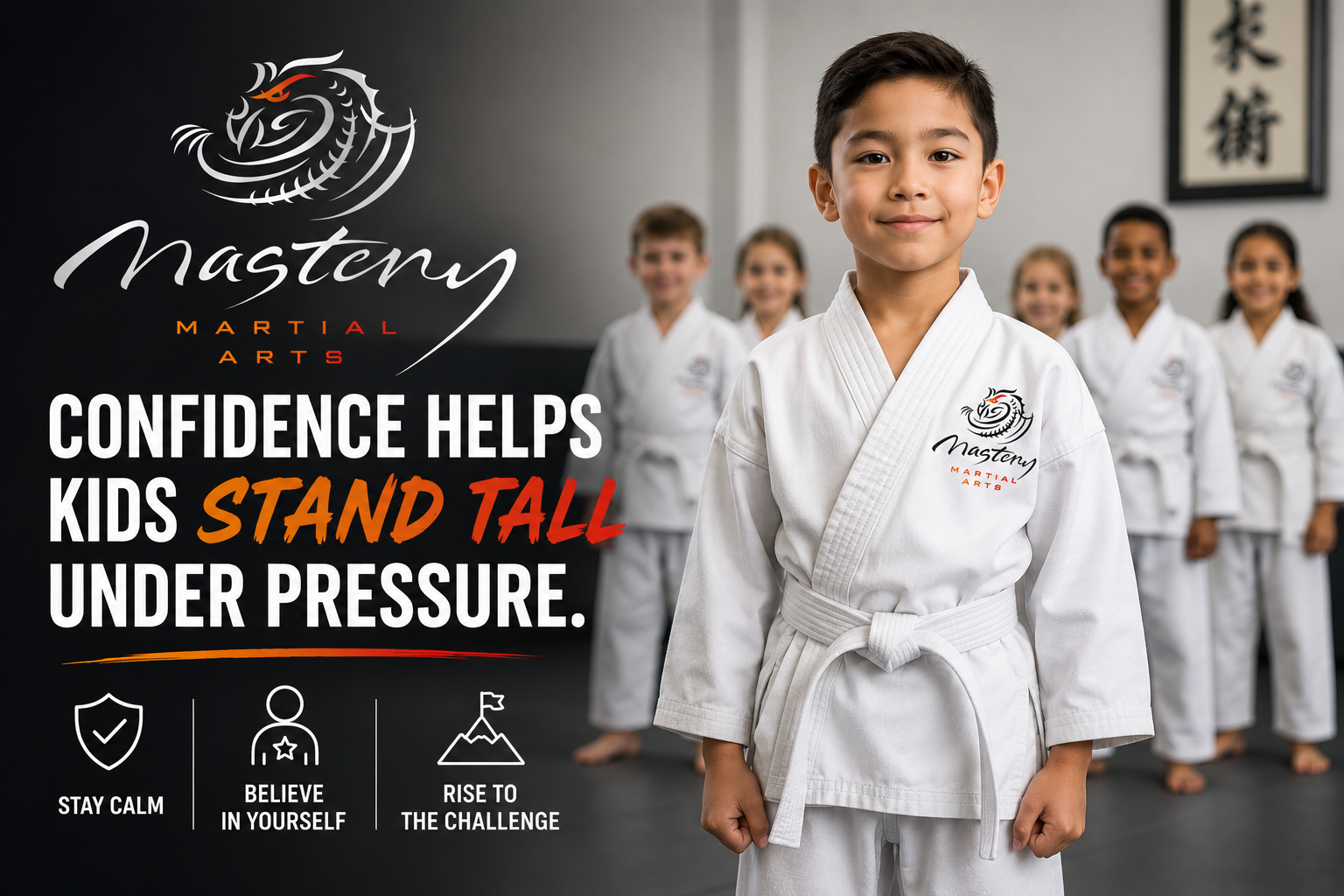
Few things impact confidence more than bullying.
Bullying attacks identity.
Children often begin asking:
What's wrong with me?
Why don't they like me?
Why am I different?
Those questions slowly erode confidence.
Confident children are often less attractive targets because they:
Set boundaries
Speak clearly
Ask for help
Project self-respect
This does not mean bullying is ever the victim's fault.
It never is.
But confidence is a genuine protective factor.
Teaching assertiveness is different than teaching aggression.
Assertiveness says:
"I respect myself enough to set a boundary."
Aggression says:
"I'm going to overpower you."
Children can learn assertiveness.
And confidence helps make it possible.
What One Barrington Parent Experienced
One Barrington parent shared:
"My daughters have grown from being shy, hesitant girls to two young warriors ready to take on the world with its many challenges. They've developed so much confidence, self-esteem, and awareness. One of them stood up for a friend who was being bullied at school."
— Dr. Rose Leandre, Mastery Martial Arts Barrington Parent
Read the full review:
https://maps.app.goo.gl/mCrBK9eyhib8JFwV8
When children develop confidence, they become more willing to stand up for themselves and others.
SOCIAL CONFIDENCE AND FRIENDSHIPS
Many confidence challenges are actually social challenges.
And many social challenges are confidence challenges.
Children need belonging.
When children struggle socially:
Confidence suffers.
When confidence suffers:
Social struggles increase.
The two reinforce each other.
Children who struggle socially often know exactly what they want to say.
They simply don't trust themselves enough to say it.
Every successful social interaction creates evidence:
I belong.
I matter.
I can connect.
That evidence becomes confidence.
CONFIDENCE, FOCUS, AND ADHD
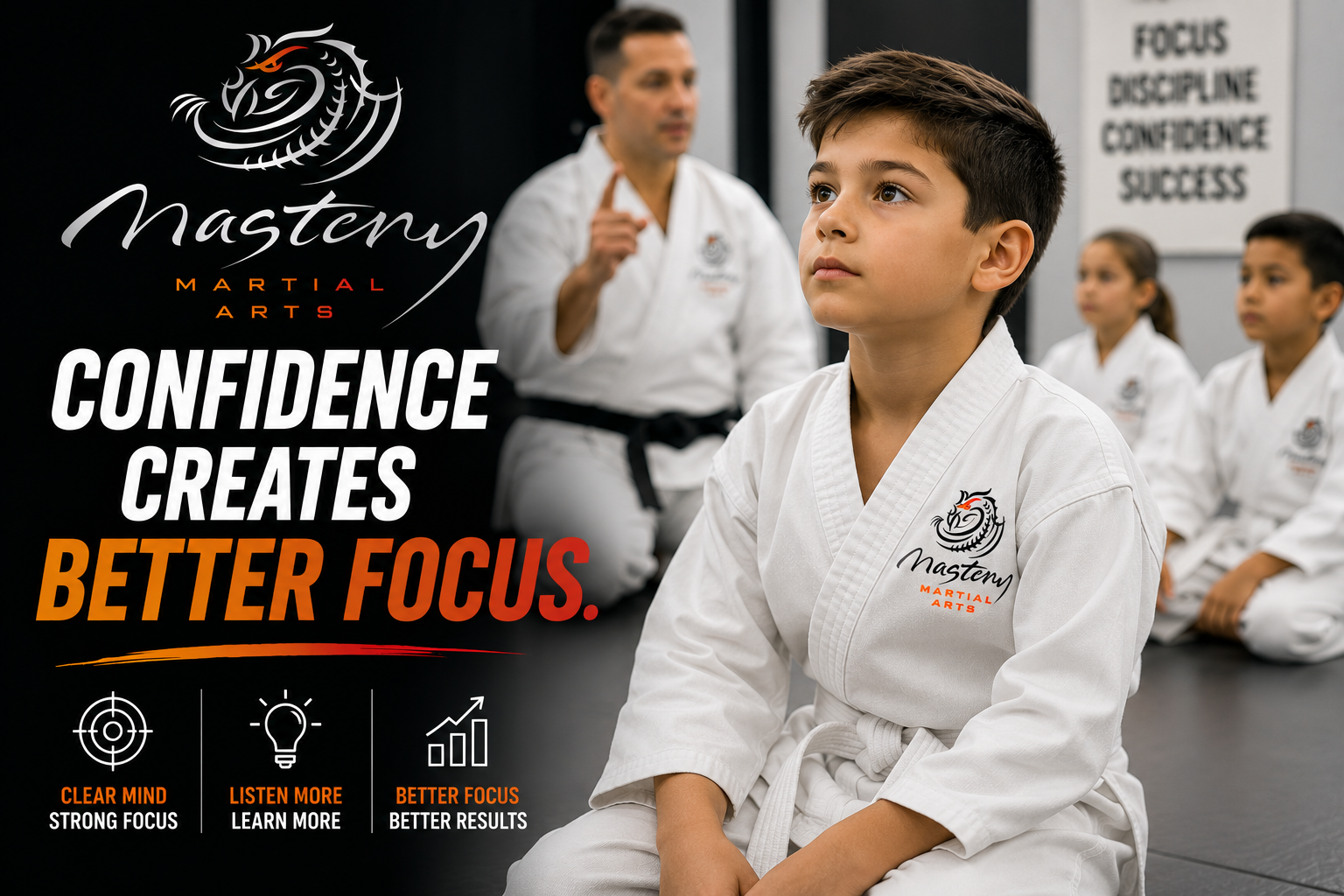
Confidence and focus are deeply connected.
Children who lack confidence often spend enormous mental energy worrying:
What if I fail?
What if I get it wrong?
What if everyone notices?
That self-doubt consumes attention.
Children with ADHD often experience repeated cycles of frustration.
Over time they begin building an identity:
"I'm bad at school."
"I can't focus."
"I'm always in trouble."
Eventually they start acting in alignment with that identity.
The solution is helping children collect new evidence.
Evidence that they are:
Capable
Improving
Intelligent
Worthy of trust
As confidence improves, performance often improves too.
What One Barrington Parent Experienced
One Barrington parent shared:
"Our son is gaining both confidence in his body and important life skills such as communication, teamwork, and leadership. He experiences challenges with ADHD, so learning these skills in this environment is incredibly valuable to our family."
— Mike Lefebvre, Mastery Martial Arts Barrington Parent
Read the full review:
https://maps.app.goo.gl/aXfnkHn2zm8L6fqL9
For many children with ADHD, confidence becomes the foundation that supports better focus, persistence, and performance.
CONFIDENCE AND LEADERSHIP DEVELOPMENT
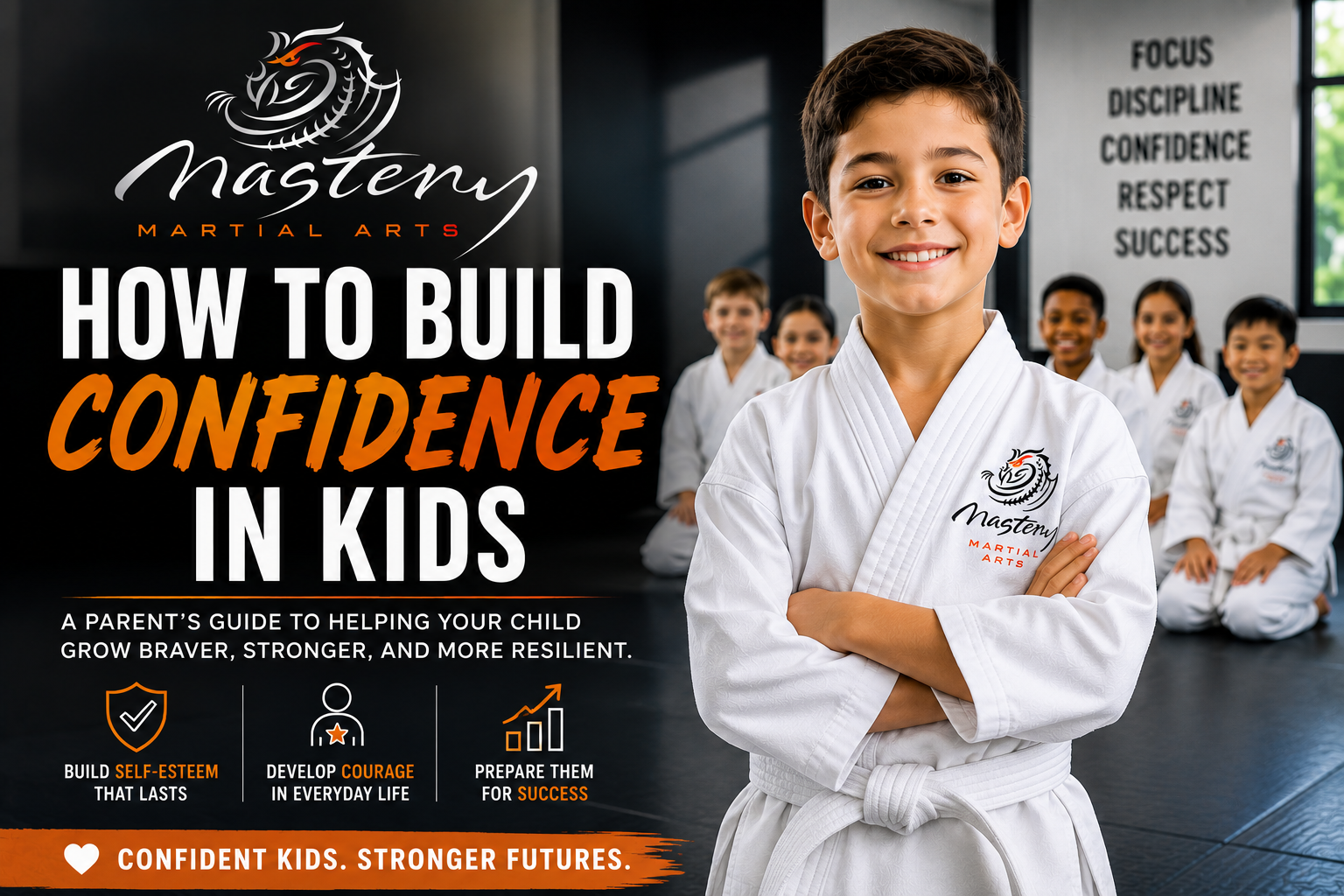
Leadership and confidence grow together.
Children rarely become leaders because they feel confident.
More often they become confident because they practiced leadership.
Leadership teaches:
Responsibility
Communication
Decision making
Accountability
Courage
Every leadership experience adds another piece of evidence:
People trusted me.
I handled it.
I can do this.
That evidence becomes confidence.
This is why leadership opportunities are one of the most effective confidence-building tools available for children.
WHY MARTIAL ARTS BUILDS CONFIDENCE SO EFFECTIVELY
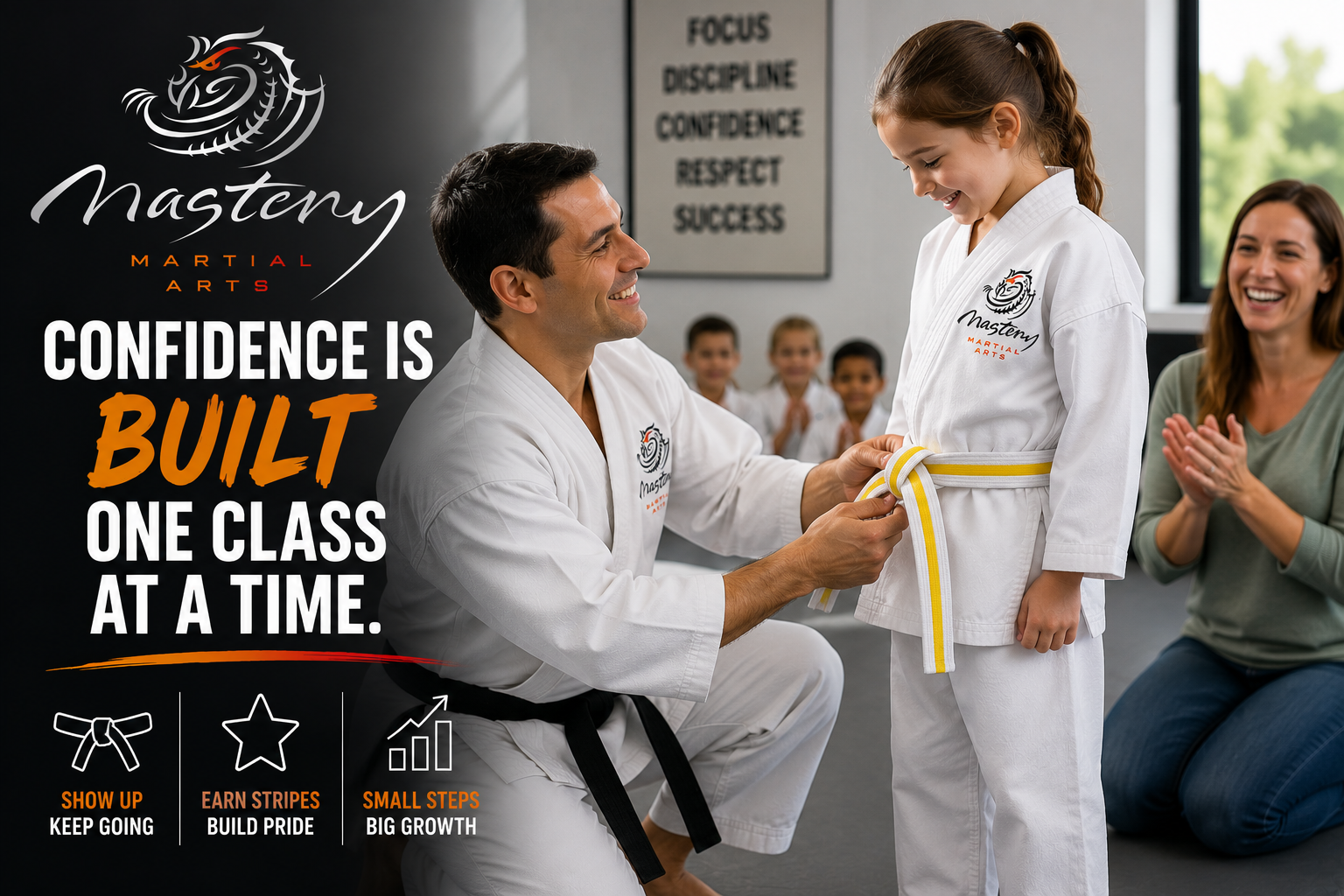
Most activities build confidence accidentally.
Martial arts builds confidence intentionally.
Everything about the structure is designed to help children grow.
Students experience:
Challenge
Progress
Recognition
Leadership
Achievement
Every class creates opportunities for success.
Every class requires effort.
Every class provides feedback.
The confidence formula is repeated over and over:
Challenge → Effort → Progress → Belief → Confidence
Belt promotions provide visible proof of growth.
Leadership opportunities provide real responsibility.
Public demonstrations help children perform under pressure.
Supportive peers create belonging.
Over time confidence becomes part of a child's identity.
Not something they occasionally feel.
Something they become.
What One North Attleboro Parent Experienced
One North Attleboro parent shared:
"I cannot express how amazing Mastery is. We joined the North Attleboro location a few weeks ago, and I can already see the difference. This is the fourth martial arts program we've tried and by far the best program overall. It not only teaches martial arts but most importantly life skills and lessons that will help when they're older. My son's behavior, respect for others, focus, and confidence have improved, which is difficult with AuDHD. We're so happy to have joined the Mastery family!"
— Natalie Wilhelm, Mastery Martial Arts North Attleboro Parent
Read the full review:
https://maps.app.goo.gl/gWEyH26k1Lc4ckrcA
This review captures something many parents discover.
Confidence is often one of the first changes they notice.
Not years later.
Weeks and months later.
Because children begin collecting evidence that they are capable.
THE CONFIDENCE JOURNEY FROM WHITE BELT TO BLACK BELT
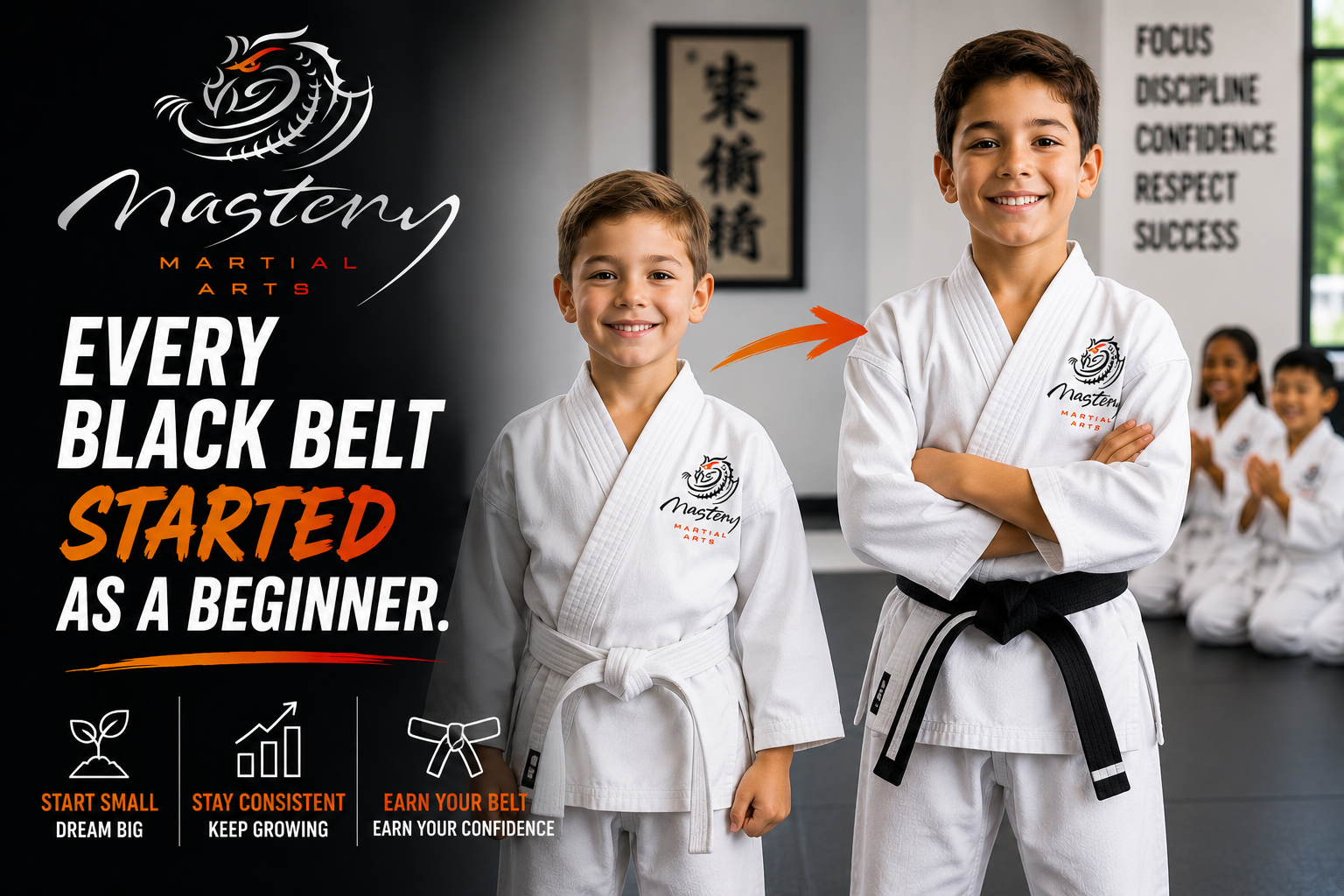
Every black belt started in the same place.
Uncertain.
Nervous.
Unsure if they belonged.
A new student walks into class and sees children who appear confident.
Children who move with certainty.
Children who seem to know exactly what they are doing.
What they don't realize is:
Those students once felt exactly the same way.
The first class is hard.
The second class feels slightly easier.
Skills improve.
Belts change.
Confidence grows.
Each milestone becomes proof.
Children stop asking:
"Can I do this?"
And begin believing:
"I've done hard things before."
That belief becomes confidence.
THE INNER BLACK BELT MINDSET
At Mastery Martial Arts, a black belt is more than a rank.
It is a mindset.
The Inner Black Belt mindset teaches children:
I can learn things I don't know yet.
I can improve.
I can overcome challenges.
I can figure things out.
I can trust myself.
These beliefs are not created through motivation.
They are earned through experience.
The Inner Black Belt mindset becomes part of how children see themselves.
And that mindset follows them everywhere:
School
Friendships
Sports
Future careers
Life
WHAT TO SAY TO YOUR CHILD: WORDS THAT BUILD CONFIDENCE
Words matter.
But some words build confidence better than others.
Instead of:
"You're so smart."
Try:
"You worked really hard on that."
Instead of:
"You're amazing."
Try:
"I noticed you didn't give up."
When children fail:
"That was hard. What did you learn?"
"You've figured out hard things before."
"What will you do differently next time?"
Before a challenge:
"You don't need to be perfect."
"You just need to try."
"I'm proud of you for showing up."
When children want to quit:
"The hardest part is usually right before improvement."
"You don't have to love it today. Let's finish what we started."
These types of statements help children focus on effort, growth, and resilience.
And those are the foundations of lasting confidence.
THE ROLE OF PHYSICAL CHALLENGE IN BUILDING MENTAL CONFIDENCE
Confidence is not just mental.
It is physical too.
When children push through physical challenges they learn:
I can do hard things.
I can keep going.
I am stronger than I thought.
The body becomes evidence.
This is one reason physical activities are so powerful for confidence development.
Martial arts combines:
Physical challenge
Mental challenge
Emotional challenge
All within a structured environment.
Children learn lessons with their bodies that become beliefs in their minds.
HOW TO CHOOSE THE RIGHT CONFIDENCE-BUILDING ACTIVITY
Not every activity builds confidence equally.
Look for activities that provide:
Structured Progression
Children need visible progress.
Appropriate Challenge
Hard enough to grow.
Not so hard they become overwhelmed.
Positive Social Environment
Supportive peers matter.
Healthy Response To Failure
Failure should be viewed as part of learning.
Long-Term Development
Confidence develops over months and years.
Not days.
The best confidence-building activities combine all five.
CONFIDENCE AT HOME: WHAT PARENTS CAN DO DAILY
Parents influence confidence more than anyone else.
Here are a few daily confidence-building habits:
Allow Appropriate Struggle
Don't solve every problem.
Let children work through challenges.
Give Responsibility
Responsibility builds competence.
Competence builds confidence.
Praise Effort
Focus on effort, persistence, and improvement.
Avoid Comparison
Compare children only to who they were yesterday.
Normalize Mistakes
Mistakes are feedback.
Not failure.
Model Confidence
Children watch how parents handle challenges.
Your example teaches more than your words.
FREQUENTLY ASKED QUESTIONS
How do I build confidence in my child?
Give them opportunities to face challenges, overcome obstacles, and experience success through effort.
Can confidence be learned?
Yes.
Confidence is a skill.
And like every skill, it can be developed.
What activities build confidence in kids?
Martial arts, leadership programs, sports, public speaking, goal-setting activities, and skill-based challenges.
Why is my child losing confidence?
Comparison, social pressure, bullying, fear of failure, and negative self-talk are common causes.
Can martial arts improve confidence?
Absolutely.
Martial arts combines challenge, achievement, leadership, and personal growth in one structured environment.
Can confidence be rebuilt after bullying?
Yes.
With support, positive experiences, and opportunities to succeed, confidence can be rebuilt.
Can shy children become confident leaders?
Absolutely.
Many strong leaders begin as quiet children who learned to trust themselves.
What age should confidence building begin?
As early as possible.
But it is never too late.
Confidence can be developed at any age.
RELATED CONFIDENCE RESOURCES
Confidence is built through hundreds of small experiences over time.
Continue exploring:
Why Kids Lose Confidence
https://masteryma.com/post/why-kids-lose-confidence
Why Kids With Low Confidence Become Quiet
https://masteryma.com/post/why-kids-with-low-confidence-become-quiet
How Bullying Impacts Confidence
https://masteryma.com/post/how-bullying-impacts-confidence
Why Confidence Comes From Doing Hard Things
https://masteryma.com/post/why-confidence-comes-from-doing-hard-things
ABOUT MASTERY MARTIAL ARTS
For more than 30 years, Mastery Martial Arts has helped children develop confidence, resilience, leadership, focus, discipline, and self-belief.
Our mission is simple:
Help children become confident leaders for life.
Through structured martial arts training, leadership development, and positive coaching, students learn they are capable of far more than they realize.
Locations throughout Rhode Island and Massachusetts.
FINAL THOUGHT
Every confident child you admire has something in common.
They were not born confident.
They built it.
One challenge.
One success.
One courageous step at a time.
Every time a child does something hard and discovers they can handle it, confidence grows.
That confidence changes:
How they think
How they act
How they feel
How they live
Because confidence doesn't just change a child's present.
It changes their future.
ACTIVATE YOUR CHILD'S FREE INTRODUCTORY LESSON
Ready to help your child build confidence, resilience, leadership, and self-belief?
Schedule your child's free introductory lesson today.
Because confidence is too important to leave to chance.
Find A Mastery Martial Arts Location Near You
Looking for a confidence-building martial arts program near you? Mastery Martial Arts has locations throughout Rhode Island and Massachusetts helping children develop confidence, leadership, focus, resilience, and life skills.
