
How to Help a Shy Child Build Confidence
HOW TO HELP A SHY CHILD BUILD CONFIDENCE

Many parents describe their child as shy.
They say things like:
"My child hides behind me when meeting new people."
"My child won't raise their hand in class."
"My child gets nervous around new kids."
"My child has trouble speaking up."
"My child is afraid to try new things."
If this sounds familiar, you're not alone.
Many children struggle with shyness at some point during childhood.
The good news is that shyness is not a permanent condition.
And confidence can be developed.
With the right experiences, encouragement, and opportunities, many shy children gradually become more comfortable expressing themselves, participating in groups, and believing in their own abilities.
NOT EVERY SHY CHILD LACKS CONFIDENCE
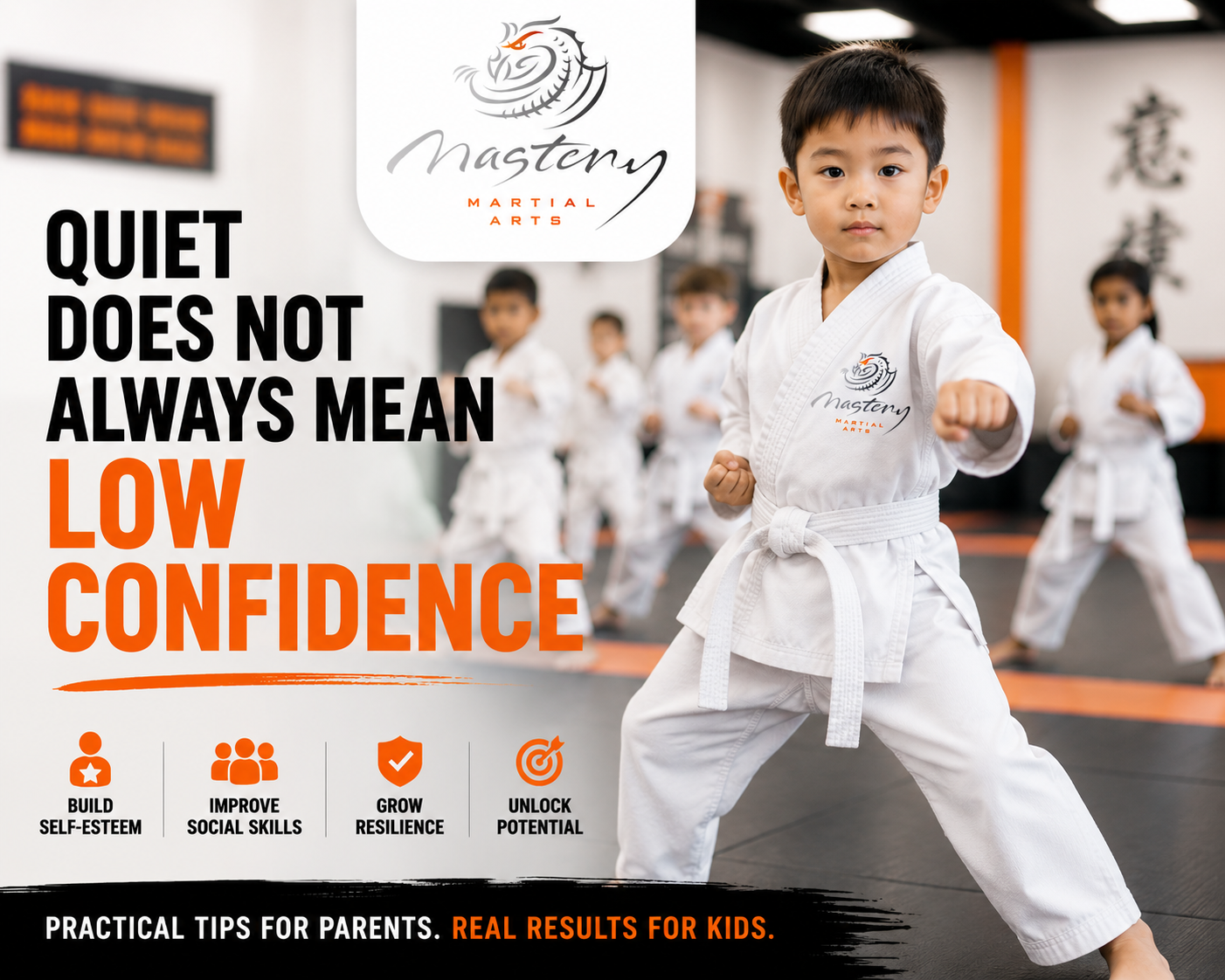
Being shy and lacking confidence are not always the same thing.
Some children are naturally more reserved.
They prefer observing before participating.
They enjoy smaller groups rather than large crowds.
There is nothing wrong with that.
However, many children who appear shy are actually struggling with self-confidence.
They worry:
"What if I say something wrong?"
"What if people laugh at me?"
"What if I fail?"
"What if nobody likes me?"
These thoughts often cause children to hold back.
Instead of expressing themselves, they become quiet.
Instead of participating, they watch.
Instead of trying, they hesitate.
If you've already read our article:
Why Kids With Low Confidence Become Quiet
https://masteryma.com/post/why-kids-with-low-confidence-become-quiet
you know that many children become quiet because they doubt themselves—not because they have nothing to say.
WHY SHY CHILDREN OFTEN AVOID NEW EXPERIENCES

Confidence grows through experience.
Unfortunately, shy children often avoid the very experiences that help build confidence.
They may avoid:
Speaking in front of groups
Joining activities
Meeting new friends
Trying unfamiliar things
Leadership opportunities
The problem is that confidence requires evidence.
Children build confidence when they discover:
"I can do this."
"I can figure this out."
"I can handle this."
When children avoid challenges, they miss opportunities to collect that evidence.
THE ROLE OF FEAR IN SHYNESS

Many shy children are not afraid of people.
They are afraid of judgment.
They worry about making mistakes.
They worry about embarrassment.
They worry about what others might think.
This often causes children to stay inside their comfort zone.
But confidence rarely grows inside a comfort zone.
Confidence grows when children discover they can handle discomfort.
If you'd like to learn more about confidence development, read:
How to Build Confidence in Kids
https://masteryma.com/post/how-to-build-confidence-in-kids
Confidence is not something children are born with.
Confidence is something they build.
WHY SOME CHILDREN BECOME MORE SHY AS THEY GET OLDER

Many parents notice something surprising.
Their child seemed outgoing when they were younger.
Then they became quieter.
More hesitant.
More self-conscious.
This often happens because children become increasingly aware of social comparison.
They begin worrying about what others think.
Peer approval becomes more important.
Fear of failure increases.
For a deeper look at this process, read:
Why Kids Lose Confidence as They Get Older
https://masteryma.com/post/why-kids-lose-confidence-as-they-get-older
Understanding what causes confidence to decline helps parents take proactive steps before self-doubt becomes a habit.
SMALL WINS CREATE BIG CONFIDENCE

One of the biggest mistakes adults make is believing confidence comes first.
It doesn't.
Action comes first.
Confidence follows.
A child introduces themselves to someone new.
A child raises their hand.
A child answers a question.
A child demonstrates a skill.
Every small success becomes evidence.
Evidence becomes belief.
Belief becomes confidence.
This is why creating opportunities for success is so important.
Small wins eventually create big changes.
WHAT ONE PARENT EXPERIENCED

Many parents describe their child as shy before they begin building confidence through new experiences.
One Barrington parent shared:
"Our daughter has been going here for a year! She loves it! Ms Lemoi is an awesome leader and really has improved our daughter's self confidence!"
— John Crowley, Mastery Martial Arts Barrington Parent
Read the full review:
https://maps.app.goo.gl/ZwjdAvD7ptwbncPT8
This review highlights an important truth about confidence.
Children rarely become more confident because someone tells them to be confident.
Confidence grows through experiences.
Through positive coaching.
Through learning new skills.
Through overcoming challenges.
And through discovering they are capable of more than they previously believed.
HOW MARTIAL ARTS HELPS SHY CHILDREN BUILD CONFIDENCE

Martial arts creates a unique environment for confidence development.
Every class gives children opportunities to:
Make eye contact
Speak clearly
Follow directions
Work with partners
Demonstrate skills
Lead activities
Overcome challenges
Children experience success regularly.
And every success adds another piece of evidence:
"I can do hard things."
Over time, many parents notice:
Increased confidence
Better communication
Improved social skills
Greater independence
More willingness to participate
Confidence becomes visible not only in class, but at home, at school, and with friends.
If you'd like to learn more about this process, read:
Raising Confident Kids Through Martial Arts
https://masteryma.com/post/raising-confident-kids-martial-arts
WHAT PARENTS CAN DO AT HOME
Parents play a major role in helping shy children build confidence.
Some simple strategies include:
Praise effort instead of outcomes
Encourage participation without forcing it
Celebrate small wins
Model confident behavior
Allow children to solve age-appropriate problems
Avoid labeling children as "shy"
Instead of saying:
"She's shy."
Try saying:
"She's still getting comfortable."
Labels can become identities.
Growth-focused language helps children see themselves as capable of change.
WHEN TO SEEK ADDITIONAL SUPPORT
Every child develops at a different pace.
However, if shyness begins interfering with friendships, school participation, emotional well-being, or daily life, additional support may be beneficial.
The earlier children begin practicing confidence-building habits, the easier it becomes to create positive momentum.
FINAL THOUGHT
A shy child is not a broken child.
Many shy children simply need opportunities to discover what they are capable of.
Confidence grows one experience at a time.
One challenge.
One success.
One courageous step forward.
The goal is not to change who your child is.
The goal is to help them become the most confident version of themselves.
RELATED CONFIDENCE RESOURCES
How to Build Confidence in Kids
https://masteryma.com/post/how-to-build-confidence-in-kids
Why Kids Lose Confidence
https://masteryma.com/post/why-kids-lose-confidence
Why Kids Lose Confidence as They Get Older
https://masteryma.com/post/why-kids-lose-confidence-as-they-get-older
Why Kids With Low Confidence Become Quiet
https://masteryma.com/post/why-kids-with-low-confidence-become-quiet
Raising Confident Kids Through Martial Arts
https://masteryma.com/post/raising-confident-kids-martial-arts
