7 Reasons Why Kids Under 10 Should Be Practicing Leadership
7 Reasons Why Kids Under 10 Should Be Practicing Leadership Now (Not Later)
Most parents assume leadership is something their child will grow into. The research — and the reality — says otherwise.
By Mastery Martial Arts · 9 min read
There's a quiet assumption that runs through a lot of parenting conversations: leadership is something for later. Middle school, maybe. High school, when they join a team or run for student council. Adulthood, when it really counts.
It's an understandable belief. But it's also one of the most costly mistakes parents make — not out of negligence, but out of genuinely not knowing how early the window opens and how quickly it begins to close.
Here's what's actually happening between ages four and ten: your child is building the mental and emotional architecture they'll live inside for the rest of their lives. Their beliefs about what they're capable of. Their default response to pressure. Their identity — the "I am" statements that become self-fulfilling over time. Leadership isn't something that gets layered on top of that foundation later. Itisthe foundation. And by the time most parents decide to focus on it, much of it is already set.
The good news? If your child is under ten, you're still inside the window. Here's why it matters — and why it matters now.
REASON 01
Leadership starts with how a child sees themselves
Before a child ever leads a group, they're leading their own inner world. The quiet conversations they have with themselves in moments of uncertainty — "Can I do this?" "What if I mess up?" "What will everyone think?" — shape their behavior long before any external situation does. A child who has learned to meet those moments with steadiness handles them very differently than one who hasn't.
When leadership is introduced early, children start to develop a new internal script. Not "I can't" but "I'll try." Not "I'm nervous" but "I can handle this." That shift isn't cosmetic. It changes how they walk into a room, how they respond when something goes wrong, how much of themselves they're willing to put forward. The most important leadership a child will ever practice isn't leading others — it's learning to lead themselves. And that practice starts here, in these early years, one small moment at a time.
REASON 02
Identity is being written right now — in real time
Between ages four and ten, children are in the middle of one of the most consequential developmental processes of their lives: deciding who they are. Not consciously, not deliberately — but through the accumulation of experiences, feedback, and repeated patterns. Every challenge they attempt or avoid, every moment they speak up or stay silent, every time they're trusted with responsibility or shielded from it is adding a sentence to a story. The story they'll carry about themselves for decades.
Without leadership experiences during this window, a different kind of identity forms by default — one built around hesitation, self-doubt, and following the path of least resistance because nothing has challenged them to do otherwise. But when kids are given real, structured opportunities to step up — to lead small groups, take ownership, try again after failure — a different identity takes shape. "I take initiative." "I help others." "I try even when it's hard." That identity doesn't disappear at adolescence. It becomes the lens through which they interpret everything that comes next.
"The most important leadership a child will ever practice isn't leading others — it's learning to lead themselves."
REASON 03
Leadership builds confidence in a way that actually holds
There's a version of confidence-building that's common in modern parenting — lots of praise, lots of affirmation, lots of "you're amazing." And it's not that encouragement is bad. It's that praise alone builds a paper-thin kind of confidence. It feels good in the moment but doesn't hold up when things get genuinely difficult. A child who's been consistently told they're great hasn't been prepared for the experience of struggling and pushing through anyway.
Leadership builds confidence differently — through responsibility, through stepping up, through earning a belief in themselves by actually living through hard moments. When a child is trusted to lead a small group in class, or asked to demonstrate something in front of others, or given ownership over a goal they have to work for — and they come through — they feel something no amount of praise can replicate. Real belief. The kind that doesn't disappear when someone criticizes them or when a challenge turns out to be harder than expected. That's the confidence worth building. And it can only be built through experience, not through words.
REASON 04
It teaches kids how to handle pressure — before it gets big
Pressure doesn't wait until adulthood to show up in a child's life. It arrives constantly, in forms that feel enormous to a young child even if they seem minor to the adults around them: speaking in front of the class, navigating a conflict with a friend, attempting something they might fail at in front of others. Without tools to handle these moments, pressure becomes something to avoid. Children learn to freeze, to shrink, to find an exit.
Leadership training gives kids a completely different relationship with pressure. Not fearlessness — that's not actually the goal — but capability. The experience of feeling nervous and acting anyway. Of being put in a situation that requires courage and discovering they had it. Every time a child navigates a moment of discomfort with support, rather than being rescued from it, they're building tolerance. They're learning that pressure is manageable. That becoming is built through doing rather than waiting. That skill — staying functional under pressure — is one of the most consequential things a person can develop. And the earlier it's practiced, the more natural it becomes.
REASON 05
Responsibility becomes a choice, not a command
Every parent has experienced the limits of telling a child to "be responsible." It's said. It's heard. And it usually produces very little change. That's because responsibility isn't absorbed through instruction — it's developed through ownership. When children have genuine things to take care of, real roles to play, and others who are counting on them, something shifts. The motivation moves from external ("I do this because I'm told") to internal ("I do this because it matters and I chose it").
Leadership creates those conditions naturally. When a child is trusted to help lead a drill, set an example for a younger student, or take ownership of their own progress and attitude, they stop waiting to be managed and start managing themselves. That transition — from compliance to ownership — is one of the most valuable things a child can develop before they reach adolescence. It affects how they approach school, how they treat others, how they handle privilege and frustration, and ultimately, what kind of person they become. It can't be lectured into them. But it can absolutely be trained.
REASON 06
It changes how they connect with other people
Leadership isn't about being the loudest, most assertive person in any room. At its best, it's about connection — the ability to communicate clearly, listen genuinely, and make the people around you feel seen and supported. These are skills that matter enormously in early childhood, when social patterns are forming and when the experience of belonging (or not belonging) has real consequences for how children see themselves.
Kids who practice leadership early tend to show up differently in social environments. They're more likely to include others, to communicate directly rather than deflect, to support a peer who's struggling rather than ignore them. They become the child other kids look to — not because they're trying to be important, but because of how they carry themselves. In a world where social anxiety among children is rising and genuine connection is harder than it looks, those skills are a real advantage. They don't develop by accident. They're built through practice, through putting kids in situations that require them to show up for other people, over and over again.
REASON 07
The habits built now become the defaults later
This is the piece that most parents don't fully reckon with until it's already happened. The behaviors a child practices between ages four and ten don't fade or reset at adolescence. They become neural patterns — the brain's default way of responding to challenge, failure, social pressure, and opportunity. Neuroscience is clear on this: the developing brain in early childhood is laying down pathways with remarkable durability. What gets practiced, gets kept.
That works in both directions. A child who practices speaking up, trying again after failure, taking initiative, and helping others is building those as defaults. A child who practices avoiding, shrinking, and waiting for others to lead is building those as defaults too — not because they chose it, but because it was never challenged. The patterns your child is rehearsing right now, in small moments that feel ordinary, will travel with them. The question isn't whether habits are forming. They always are. The question is which habits.
"Leadership doesn't suddenly appear at 16 or 22. It either was practiced — or it wasn't."
What leadership actually looks like for a child under 10
When most people picture a leader, they picture someone in charge — a team captain, a speaker, someone at the front of the room. For young children, none of that applies. And one of the things that holds parents back from prioritizing leadership development is that they don't recognize what it actually looks like at this age.
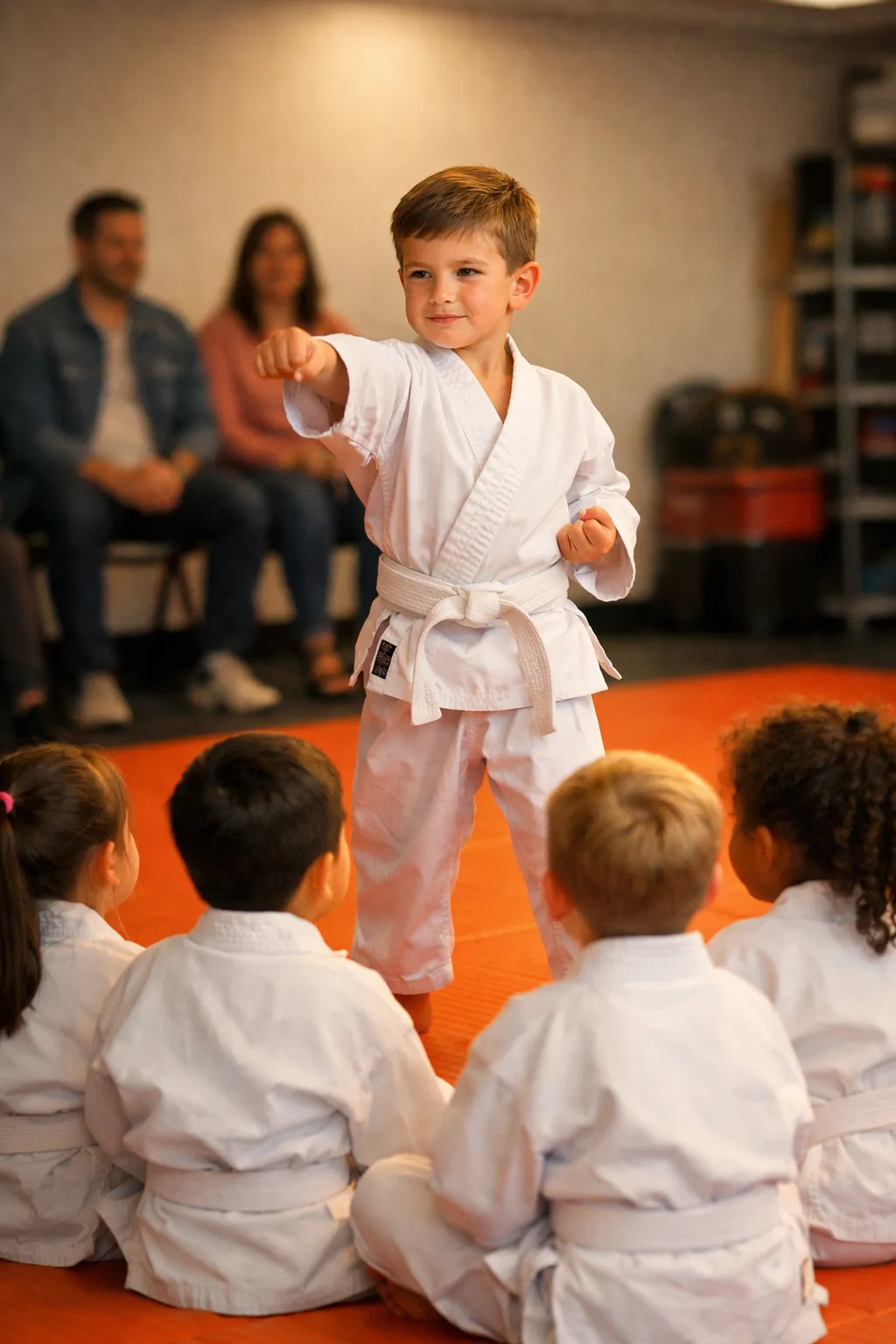
At its most honest, leadership for a young child looks like this: raising a hand even when they're unsure of the answer. Trying again after making a mistake without being prompted. Helping a friend who's struggling, even when no one's watching. Standing tall when something feels scary instead of looking for the exit. It's not about power or position. It's about presence — the quiet but unmistakable quality of a child who has learned to show up, even when showing up is hard.
Here's the thing most parents feel but rarely say out loud: they don't want to wait until their child is already struggling — already playing small, already avoiding, already defined by self-doubt — to wish they had started earlier.
The window is open. The habits are forming either way. The only real choice is whether they form intentionally, through practice and challenge and guided experience, or by default — through whatever path of least resistance your child finds when nobody's given them something more demanding to aim for.
How we build this at Mastery Martial Arts
At Mastery Martial Arts, leadership isn't a title you earn or a reward for the most talented kid in the room. It's a skill we build into every single class — through structured training, real responsibility, and consistent, guided challenge.
Kids are coached to lead small groups, demonstrate skills in front of others, encourage and support their teammates, and take genuine ownership of their effort and attitude. Not perfectly. Consistently. Because leadership isn't built in one big moment — it's built through repetition, experience, and doing the same hard thing enough times that it stops feeling quite so hard.
If you want your child to develop confidence, responsibility, and the kind of inner leadership that lasts — we'd love to show you what that looks like in practice.
See how it works ↗
What Warwick Families Are Saying
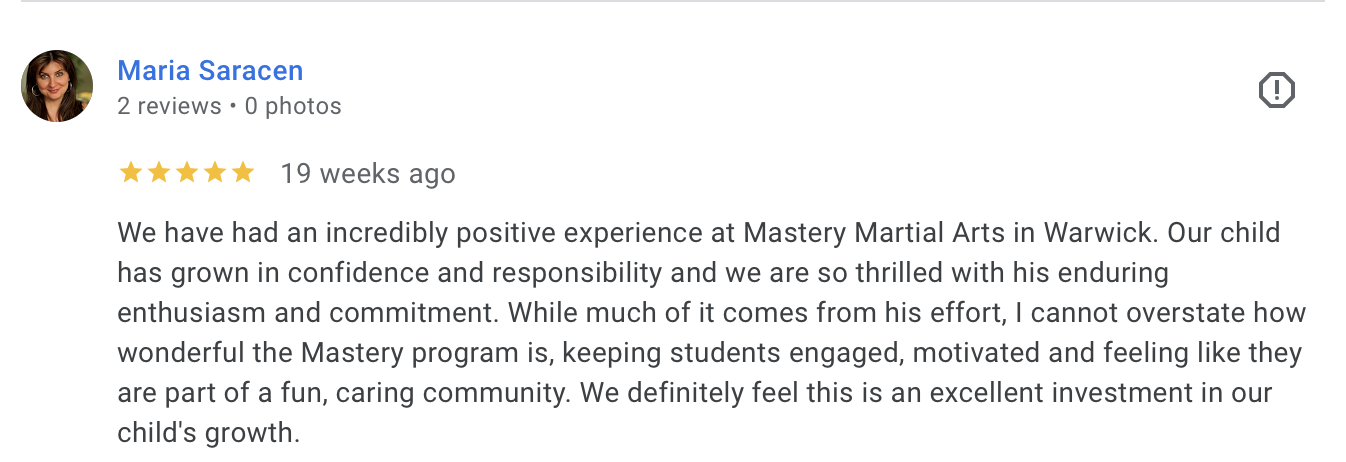
Many Warwick parents are searching for more than just an activity for their child. They want a place where their child feels supported, challenged, encouraged, and surrounded by positive leadership.
That’s why this review from a Warwick parent reflects so much of what families experience at Mastery Martial Arts:
“We have had an incredibly positive experience at Mastery Martial Arts in Warwick. Our child has grown in confidence and responsibility… keeping students engaged, motivated and feeling like they are part of a fun, caring community.”
One of the most powerful things a child can develop is belief in themselves — and that confidence often starts with consistent encouragement, structure, and positive role models.
At Mastery Martial Arts Warwick, our mission is to help children grow stronger physically, mentally, emotionally, and socially through purposeful martial arts training and leadership development.
Read the full parent review here:
https://maps.app.goo.gl/JpbmRDCi5WU5uY4o6
Confidence is one of the first layers of leadership.
And for kids under 10, it must be built early.
If you haven’t read this yet, it connects directly:
https://masteryma.com/post/kids-confidence-development-under-10
Because leadership without confidence…
Doesn’t hold.
