The Science Behind Martial Arts and Academic Performance: How Training Improves Grades

The Science Behind Martial Arts and Academic Performance
Published: October 10, 2025 | Reading Time: 8 minutes
Every parent wants their child to succeed academically, but traditional approaches to improving grades—more tutoring, longer study sessions, additional homework—often fall short of expectations. What if the key to unlocking your child's academic potential isn't found in another workbook or study guide, but on a martial arts training mat?
Recent scientific research is revealing what martial arts instructors have observed for decades: children who practice martial arts consistently show improved academic performance across multiple subjects. This isn't just correlation—it's causation, backed by rigorous scientific studies that demonstrate how martial arts training literally rewires the brain for better learning, focus, and academic achievement.
At Mastery Martial Arts™, we've witnessed this transformation countless times. Parents regularly report that their children's grades improve after beginning martial arts training, often within just a few months. Teachers notice better classroom behavior, improved attention spans, and enhanced learning ability. But until recently, we could only point to anecdotal evidence and observable changes.
Now, cutting-edge neuroscience research is providing the scientific explanation for what we've been seeing all along. Studies published in prestigious journals like Pediatrics, Developmental Psychology, and the Journal of Cognitive Enhancement are demonstrating the specific ways martial arts training enhances cognitive function, executive skills, and academic performance.
Today, we're exploring the fascinating science behind martial arts and academic achievement, examining the research that proves martial arts isn't just good exercise—it's brain training that creates lasting improvements in learning ability, focus, and academic success.
When parents arechoosing a martial arts program, academic benefits are often a pleasant surprise.
The Neuroscience of Martial Arts Training
To understand how martial arts improves academic performance, we need to examine what happens in the brain during martial arts training and how these changes translate to enhanced learning ability.
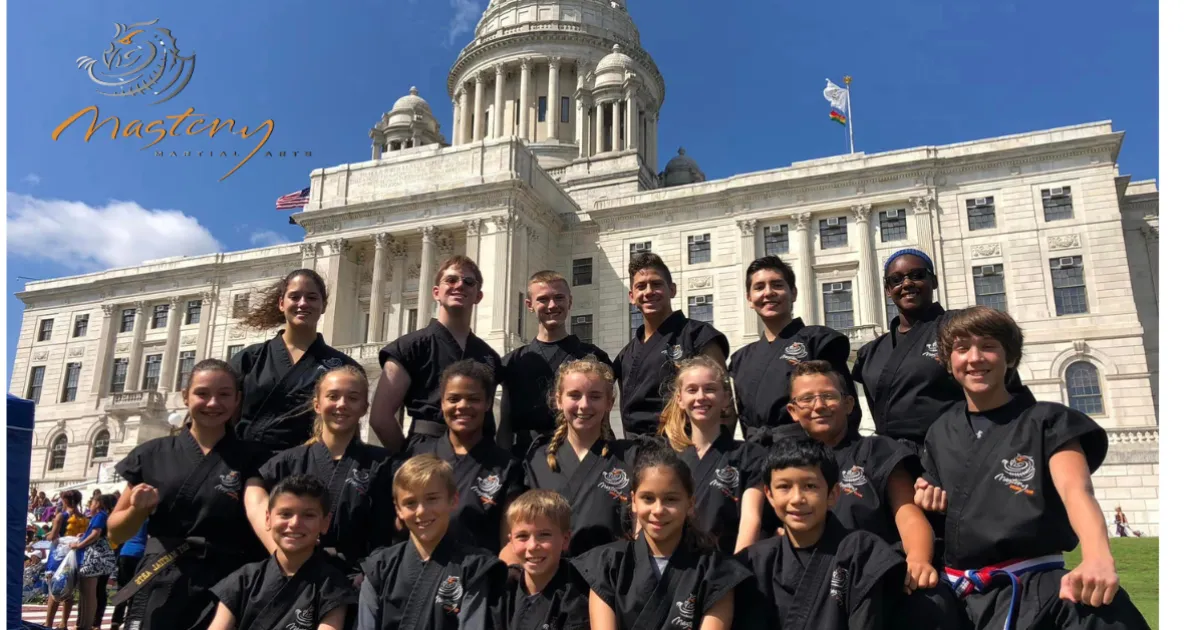
Check out the Mastery Demo Team:
Brain Development and Neuroplasticity
Neuroplasticity Activation: Martial arts training stimulates neuroplasticity—the brain's ability to form new neural connections and reorganize existing pathways. This enhanced plasticity improves the brain's capacity for learning and adaptation.
Prefrontal Cortex Development: Research shows that martial arts training specifically strengthens the prefrontal cortex, the brain region responsible for executive functions like working memory, cognitive flexibility, and inhibitory control—all crucial for academic success.
Cross-Lateral Movement Benefits: The complex, coordinated movements in martial arts require both sides of the brain to work together, strengthening the corpus callosum (the bridge between brain hemispheres) and improving overall cognitive integration.
Stress Response Regulation: Martial arts training helps regulate the hypothalamic-pituitary-adrenal (HPA) axis, reducing chronic stress that can impair learning and memory formation.
Executive Function Enhancement
Working Memory Improvement: Studies demonstrate that martial arts training significantly improves working memory—the ability to hold and manipulate information in mind while performing cognitive tasks. This directly impacts reading comprehension, mathematical problem-solving, and complex reasoning.
Inhibitory Control Development: The self-control required in martial arts training strengthens inhibitory control—the ability to resist impulses and maintain focus despite distractions. This skill is crucial for classroom attention and study habits.
Cognitive Flexibility: Learning martial arts forms and adapting techniques to different situations develops cognitive flexibility—the ability to switch between different concepts or adapt thinking to new situations. This skill enhances problem-solving and creative thinking.
Attention Regulation: The focused attention required during martial arts practice strengthens attention networks in the brain, improving sustained attention and selective attention abilities that are essential for academic learning.
Research Evidence: The Studies That Prove the Connection
Multiple peer-reviewed studies have documented the positive impact of martial arts training on academic performance, providing compelling evidence for this brain-body connection.
The University of Madrid Study
Study Design: Researchers conducted a comprehensive one-year study with primary school children, implementing a school-based karate intervention and measuring academic achievement, conduct problems, and physical fitness.
Key Findings: Children who participated in the karate program showed significant improvements in academic achievement across multiple subjects, with particularly strong gains in mathematics and reading comprehension.
Behavioral Improvements: The study also documented reduced conduct problems and improved classroom behavior, creating a better learning environment for all students.
Long-Term Effects: Follow-up assessments showed that academic improvements persisted even after the formal intervention ended, suggesting lasting changes in cognitive function.
The Cognitive Enhancement Research
Executive Function Study: Research published in the Journal of Cognitive Enhancement found that children practicing martial arts demonstrated superior executive functioning compared to control groups, with measurable improvements in:
• Working memory capacity
• Cognitive flexibility
• Inhibitory control
• Processing speed
Academic Transfer: These executive function improvements directly translated to better academic performance, with martial arts students showing enhanced performance on standardized tests and classroom assessments.
Attention Studies: Multiple studies have documented improved attention spans in children who practice martial arts, with some research showing attention improvements of up to 30% compared to control groups.
The ADHD and Learning Differences Research
ADHD Intervention Studies: Research specifically examining martial arts as an intervention for children with ADHD has shown remarkable results:
• Significant improvements in attention and focus
• Reduced hyperactivity and impulsivity
• Better emotional regulation
• Improved academic performance
Learning Differences Support: Studies with children who have various learning differences show that martial arts training can help compensate for cognitive challenges by strengthening alternative neural pathways and improving overall brain function.
Medication Complement: Some research suggests that martial arts training can enhance the effectiveness of ADHD medications while potentially reducing the need for higher dosages.
How Martial Arts Develops Academic Skills
The connection between martial arts and academic performance isn't mysterious—specific aspects of martial arts training directly develop the cognitive skills needed for academic success.
The same focus and discipline that makes martial arts safe alsoimproves behavior at home and school.
Focus and Concentration Development
Sustained Attention Training: Martial arts requires sustained attention for extended periods, gradually building the attention span needed for academic tasks like reading, studying, and test-taking.
Selective Attention Skills: Students learn to focus on relevant information while filtering out distractions—a crucial skill for classroom learning and homework completion.
Attention Switching: Martial arts training requires rapid switching between different types of attention (focused, divided, sustained), developing cognitive flexibility that enhances learning ability.
Mindfulness Integration: Many martial arts incorporate mindfulness practices that strengthen attention networks and improve the ability to maintain focus despite internal or external distractions.
Memory Enhancement
Procedural Memory: Learning martial arts forms and techniques strengthens procedural memory systems that support skill acquisition in academic subjects.
Working Memory Training: The complex sequences and combinations in martial arts provide intensive working memory training that directly benefits academic tasks requiring mental manipulation of information.
Long-Term Memory Consolidation: The repetitive practice inherent in martial arts training strengthens memory consolidation processes, improving the ability to retain and recall academic information.
Spatial Memory Development: Many martial arts techniques involve spatial relationships and movement patterns that enhance spatial memory and mathematical reasoning abilities.
Problem-Solving Skills
Strategic Thinking: Martial arts training, particularly sparring and application exercises, develops strategic thinking skills that transfer to academic problem-solving.
Pattern Recognition: Learning to recognize and respond to different techniques and situations enhances pattern recognition abilities crucial for mathematics, reading, and scientific reasoning.
Adaptive Thinking: The need to adapt techniques to different situations develops cognitive flexibility and creative problem-solving skills.
Analytical Skills: Breaking down complex techniques into component parts develops analytical thinking skills that benefit all academic subjects.
Subject-Specific Academic Benefits
Research shows that martial arts training provides specific benefits for different academic subjects, with some areas showing particularly strong improvements.
Mathematics Performance
Spatial Reasoning: The spatial awareness developed through martial arts training directly benefits mathematical reasoning, particularly in geometry and spatial problem-solving.
Sequential Processing: Learning martial arts forms requires sequential processing skills that support mathematical procedures and multi-step problem-solving.
Pattern Recognition: The pattern recognition skills developed in martial arts enhance mathematical thinking and the ability to recognize numerical relationships.
Logical Reasoning: The cause-and-effect relationships inherent in martial arts techniques develop logical reasoning skills crucial for mathematical proof and problem-solving.
Reading and Language Arts
Attention to Detail: The precision required in martial arts training develops attention to detail that benefits reading comprehension and writing skills.
Sequential Processing: Following complex martial arts instructions enhances sequential processing abilities crucial for reading comprehension and following written directions.
Vocabulary Development: Learning martial arts terminology and concepts expands vocabulary and language processing skills.
Comprehension Skills: The need to understand and apply complex instructions in martial arts develops comprehension skills that transfer to reading and academic learning.
Science Performance
Observation Skills: Martial arts training develops keen observation skills that benefit scientific inquiry and experimentation.
Hypothesis Testing: The trial-and-error process of perfecting techniques develops hypothesis testing and experimental thinking skills.
Cause-and-Effect Understanding: Understanding how different techniques produce different results develops causal reasoning crucial for scientific thinking.
Systematic Thinking: The systematic approach to learning martial arts techniques develops organized thinking skills that benefit scientific methodology.
The Role of Physical Exercise in Cognitive Enhancement
The physical exercise component of martial arts training provides additional cognitive benefits that support academic performance.
Brain-Derived Neurotrophic Factor (BDNF)
Neuroplasticity Enhancement: Physical exercise increases production of BDNF, a protein that promotes neuroplasticity and supports learning and memory formation.
Cognitive Protection: Higher BDNF levels protect against cognitive decline and support optimal brain function throughout the lifespan.
Learning Facilitation: Increased BDNF production creates optimal conditions for learning and memory consolidation, enhancing the effectiveness of academic instruction.
Cardiovascular Benefits for Brain Function
Improved Blood Flow: Cardiovascular exercise increases blood flow to the brain, delivering oxygen and nutrients needed for optimal cognitive function.
Neurogenesis Stimulation: Regular exercise stimulates the growth of new brain cells, particularly in the hippocampus, which is crucial for learning and memory.
Stress Hormone Regulation: Exercise helps regulate stress hormones like cortisol that can impair learning and memory when chronically elevated.
Sleep Quality Improvement
Better Sleep Patterns: Regular physical activity improves sleep quality, which is crucial for memory consolidation and cognitive function.
Attention Restoration: Quality sleep helps restore attention networks and cognitive resources needed for academic performance.
Emotional Regulation: Better sleep supports emotional regulation, creating optimal conditions for learning and academic engagement.
Character Traits That Support Academic Success
Beyond cognitive benefits, martial arts develops character traits that directly support academic achievement and lifelong learning.
Self-Discipline and Study Habits
Consistent Practice: The discipline required for regular martial arts training develops habits of consistent effort that transfer to study routines and homework completion.
Delayed Gratification: Working toward long-term goals like belt advancement teaches delayed gratification skills crucial for academic success.
Personal Responsibility: Taking responsibility for one's progress in martial arts develops accountability that extends to academic performance.
Time Management: Balancing martial arts training with other activities develops time management skills that benefit academic scheduling and organization.
Goal-Setting and Achievement
Progressive Goals: The belt system teaches systematic goal-setting and achievement, skills that directly transfer to academic goal-setting.
Persistence Through Challenges: Learning difficult techniques develops persistence and resilience that help students overcome academic challenges.
Growth Mindset: The continuous improvement focus in martial arts develops a growth mindset that enhances learning ability and academic motivation.
Self-Efficacy: Achieving martial arts goals builds self-efficacy—the belief in one's ability to succeed—which positively impacts academic confidence and performance.
Stress Management and Emotional Regulation
Anxiety Reduction: The stress management techniques learned in martial arts help students manage test anxiety and academic pressure more effectively.
Emotional Control: Learning to control emotions during challenging training situations develops emotional regulation skills that support academic focus and performance.
Confidence Building: The confidence developed through martial arts achievement reduces academic anxiety and increases willingness to participate in challenging academic activities.
Resilience Development: Learning to bounce back from mistakes and setbacks in martial arts develops resilience that helps students persist through academic difficulties.
The Mastery Martial Arts™ Academic Enhancement Approach
At Mastery Martial Arts™, we've developed specific strategies to maximize the academic benefits of martial arts training while maintaining our focus on character development and martial arts excellence.
Cognitive Integration Training
Mindful Practice: We incorporate mindfulness techniques that enhance the cognitive benefits of physical training while developing attention and focus skills.
Cross-Training Benefits: Our curriculum includes activities that specifically target executive function skills while maintaining the traditional martial arts focus.
Academic Application: We help students understand how the skills they're developing in martial arts apply to their academic work and study habits.
Progress Tracking: We track both martial arts progress and academic improvements, helping students and parents see the connections between training and academic success.
Study Skills Integration
Goal-Setting Transfer: We explicitly teach students how to apply the goal-setting skills they learn in martial arts to their academic goals and study plans.
Focus Training: Our classes include specific exercises designed to develop sustained attention and concentration skills that directly benefit academic work.
Memory Techniques: We incorporate memory training exercises that support both martial arts learning and academic retention.
Stress Management: We teach stress management techniques that help students handle academic pressure and test anxiety more effectively.
Parent Partnership for Academic Success
Home Study Support: We provide parents with strategies for reinforcing the focus and discipline skills their children develop in martial arts during home study time.
Academic Goal Integration: We work with families to integrate martial arts goal-setting with academic goals, creating a comprehensive approach to achievement.
Progress Communication: We maintain regular communication with parents about their child's development and how it's impacting their academic performance.
Teacher Collaboration: When appropriate, we collaborate with teachers to support students' academic success through consistent approaches to focus, discipline, and goal achievement.
Real-World Academic Improvements
The academic benefits of martial arts training aren't just theoretical—they're evident in the real-world improvements we see in our students' academic performance.
Grade Improvements
Consistent Patterns: We regularly see students' grades improve within 3-6 months of beginning martial arts training, with improvements often sustained throughout their academic careers.
Subject-Specific Gains: While improvements occur across subjects, we often see particularly strong gains in mathematics and reading comprehension.
Standardized Test Performance: Many students show improved performance on standardized tests, with gains in both academic content and test-taking skills.
Long-Term Academic Success: Students who continue martial arts training often show sustained academic improvement and increased likelihood of pursuing higher education.
Classroom Behavior Improvements
Teacher Reports: Teachers frequently report improvements in attention, participation, and classroom behavior among students who practice martial arts.
Homework Completion: Parents report better homework completion rates and improved study habits among children who practice martial arts.
Academic Engagement: Students often show increased interest in learning and greater willingness to tackle challenging academic tasks.
Leadership Development: Many martial arts students take on academic leadership roles, such as peer tutoring or student government positions.
Special Needs Success Stories
ADHD Improvements: Students with ADHD often show remarkable improvements in attention, focus, and academic performance through martial arts training.
Learning Differences Support: Children with various learning differences often find that martial arts training helps them develop alternative strategies for academic success.
Confidence Building: Students who struggle academically often experience significant confidence boosts that improve their overall academic engagement and performance.
Getting Started: Maximizing Academic Benefits
If you're interested in using martial arts to support your child's academic success, here are strategies to maximize the academic benefits of training.
"These cognitive improvements contribute to theunshakeable confidence.
Choosing the Right Program
Academic-Aware Instructors: Look for instructors who understand the connection between martial arts training and academic performance and can help students make these connections.
Focus on Fundamentals: Choose programs that emphasize the fundamental skills—focus, discipline, goal-setting—that most directly support academic success.
Character Development: Ensure the program includes explicit character development that reinforces the traits needed for academic success.
Individual Attention: Look for programs that provide individual attention and can adapt to your child's specific academic needs and goals.
Supporting the Transfer
Make Connections: Help your child understand how the skills they're learning in martial arts apply to their academic work.
Reinforce at Home: Use martial arts principles like goal-setting and persistent practice to support homework and study routines.
Communicate with Teachers: Share information about your child's martial arts training with teachers so they can reinforce the positive changes they observe.
Track Progress: Monitor both martial arts progress and academic improvements to help your child see the connections between training and academic success.
Conclusion: The Academic Advantage of Martial Arts
The science is clear: martial arts training provides significant cognitive and academic benefits that extend far beyond physical fitness and self-defense skills. From enhanced executive function and improved attention to better stress management and stronger character traits, martial arts creates the optimal conditions for academic success.
At Mastery Martial Arts™, we've seen these benefits play out in the lives of thousands of students. Children who struggle with focus develop laser-like concentration. Students who lack confidence discover their academic potential. Kids who have difficulty with self-discipline learn to manage their time and effort effectively.
The beauty of martial arts is that these academic benefits aren't the result of additional academic pressure or more homework—they're the natural outcome of developing the cognitive skills, character traits, and physical health that support optimal learning. Students don't just get better grades; they become better learners.
If you want to give your child every possible advantage for academic success, consider the scientifically-proven benefits of martial arts training. The investment in your child's martial arts education isn't just an investment in their physical skills or character development—it's an investment in their academic future and lifelong learning ability.
The research is compelling, the benefits are proven, and the results speak for themselves. Martial arts isn't just good for your child's body and character—it's one of the most effective ways to enhance their academic potential and set them up for educational success.
Ready to unlock your child's academic potential through martial arts? Contact Mastery Martial Arts™ today to schedule a trial class and discover how our scientifically-informed approach to martial arts training can enhance your child's focus, learning ability, and academic performance. Give your child the cognitive advantage that lasts a lifetime.
## Related Articles:
-How to Choose the Right Martial Arts Program for Your Child.
-How Martial Arts Teaches Respect and Discipline at Home and School.
-Martial Arts vs. Other Activities: Making the Right Choice.
