

THE PARENT'S INNER BLACK BELT
Parent Development | 7 min read
Here's something we rarely say out loud in the dojo but probably should say more often: the most important belt your child needs you to earn isn't hanging on the wall. It's the one you build inside yourself.
Every week, parents bring their kids to class and hope something sticks. They watch their child struggle with focus, or push back on structure, or give up when things get hard and they wonder what more they can do. More encouragement? More discipline? A different approach at home?
Those things matter. But there's a deeper question underneath all of it, one that martial arts philosophy has always pointed toward:Who are you beingin the moments that count?
Your child doesn't just learn from what you say. They learn from the environment of who you are. Your energy when things go sideways, your reaction when you're frustrated, the way you talk about failure, the way you carry stress. Children are extraordinarily perceptive. They absorb all of it, consciously and unconsciously, long before they can name what they're taking in.
This is what we call the Parent's Inner Black Belt. And earning it requires the same thing every black belt requires: honest self-examination, consistent practice, and a willingness to be a student again.
The Work Most People Avoid
Inner work is hard to sell. It doesn't have a visible result you can point to. There's no belt ceremony, no moment where someone pins a new rank on you and the room applauds. It happens quietly, in the unglamorous spaces. A Tuesday morning when everything is running late, a car ride home after a rough practice, a dinner table disagreement that escalates faster than anyone intended.
What makes it difficult isn't the effort. It's the honesty it requires. To pursue your own Inner Black Belt, you have to be willing to look at your triggers. The specific moments that knock you off center. Your patterns. The automatic responses you've been running for years, often inherited from your own upbringing. Your reactions. The split-second choices that happen before you've even consciously decided anything.
When your child triggers you, it isn't just about them. It's revealing something in you that's ready to grow.
That's not a comfortable idea. But it's a freeing one. Because it means every difficult moment with your child isn't a failure. It's information. It's a window into something in yourself that's been waiting for attention.
Four Levels of Inner Awareness
Just as we progress through ranks on the mat, inner self-mastery develops in stages. These aren't levels you pass through once and leave behind. They're capacities you deepen over time, returning to again and again as life brings new challenges.
Level 1: AwarenessYou begin noticing what's happening inside you in real time. "Why did that frustrate me?" "Why did I react so quickly?" "What was I actually feeling under that anger?" Most people never slow down enough to ask these questions. Getting here is already significant.
Level 2: SeparationYou create space between what happens and how you respond. This is where real power begins. Instead of being pulled immediately into automatic reaction, you find a pause, even a small one, where choice becomes possible. That space is everything.
Level 3: ChoiceNow you can ask, in the moment: "How do I want to show up right now?" Not from stress, not from habit, not from the emotional weather of the day, but from intention. From the kind of parent, partner, and person you've decided you want to be.
Level 4: IdentityOver time, you stop trying to respond well and you simply do. The calm under pressure isn't performed anymore. The groundedness in chaos isn't forced. It becomes who you are. This is the Inner Black Belt: not a technique, but an identity.
Your Reactions Are Not Random
One of the most liberating realizations in this work is understanding that your emotional reactions aren't character flaws. They're patterns. Patterns built from years of experience, messages absorbed in childhood, beliefs you formed about yourself and the world long before you had the language to question them.
The parent who explodes over small messes may have grown up in a household where disorder felt dangerous. The parent who goes cold and distant during conflict may have learned early that expressing emotion wasn't safe. The parent who micromanages every outcome may be running on a deep, quiet fear that things left alone fall apart.
None of this is destiny. But none of it changes without awareness, either. And here's what's worth understanding clearly: your children are not the cause of these patterns. They're the mirror. They bring them to the surface, reliably and often inconveniently, in ways that give you exactly the opportunity to work on them.
The question is whether you take it.
A Daily Practice That Actually Works
Inner work doesn't require hours of journaling or retreats or dramatic transformation. It requires consistency in small moments. Here are three simple touchpoints that, practiced regularly, compound into something powerful.
Morning: "Who do I choose to be today?"Before the day pulls you into its current, take thirty seconds to set your intention. Not a to-do list, but an identity. Patient. Present. Grounded. Pick one word and carry it.
In the Moment: "What am I actually feeling right now?"When you feel the charge rising, frustration, overwhelm, the urge to shut down, pause. Name what's underneath it. Naming the emotion begins to dissolve its grip on your behavior.
After: "Where did I grow? Where did I slip?"A brief, judgment-free review at the end of the day. Not to beat yourself up, but to learn. Growth comes from honest reflection, not from perfection.
You don't have to do all three immediately. Pick one and build from there. The point isn't a perfect routine. It's a consistent direction.
What You're Actually Aiming For
Let's be clear about the standard because it's often misunderstood. Earning your Inner Black Belt doesn't mean becoming someone who never gets frustrated, never raises their voice, never has a hard day. That's not a human being; that's a performance. And children see through performances with perfect clarity.
What you're aiming for is something more honest and more achievable: becoming aware faster. Recovering more quickly when you slip. Making better choices more often than you used to. Growing in a deliberate direction, year after year, rather than simply reacting to whatever life brings.
The standard is not perfection. The standard is intentional growth.
The Ripple Effect You Don't See Coming
Here's what surprises most parents who commit to this work: the results show up in their children before they fully recognize them in themselves.
The home feels calmer, not because the chaos is gone, but because your presence anchors it differently.
Your child takes more risks, fails more gracefully, and bounces back faster because they've watched you model exactly that.
Conflict in the house de-escalates more quickly because you're not adding fuel to fires you used to ignite.
Your child starts using language around emotions and choices that you didn't explicitly teach. They absorbed it from watching you.
The relationship between you shifts, subtly but undeniably, into something with more trust and more space.
None of this happens through a single conversation or a parenting book or a new strategy. It happens through the accumulated weight of who you are, day after day, in the small moments nobody's filming.
Without saying a word, you teach your child how to master themselves simply by mastering yourself.
One Question That Changes Everything
We'll leave you with this. It's simple. You can use it today, in any moment that challenges you. A tense morning, a frustrating pickup, a disagreement that catches you off guard.
Ask yourself:"What is this moment trying to teach me about myself?"
That shift, from "how do I fix this situation" to "what is this situation here to show me," is the beginning of everything. It takes the pressure off and turns every difficult moment into a training session. Which, if you think about it, is exactly what we do on the mat.
You've invested in your child's training. You're watching them grow. Now consider: what would it look like to train with the same seriousness yourself?
The dojo has always been about more than kicks and forms. It's always been about the person you're becoming. That applies to you, too.
Your child is watching. And they need you to be their greatest teacher, not through what you say, but through who you are.
That belt is waiting for you to earn it.
About Mastery Martial Arts
At Mastery Martial Arts, we know your child’s growth doesn’t just happen in class.
It’s shaped by the environment at home and by you.
That’s why we don’t just coach kids. We support parents in building their Inner Black Belt so they can lead with calm, confidence, and intention in the moments that matter most.
When you grow, your child feels it. And everything starts to shift.
What Cumberland Families Are Saying
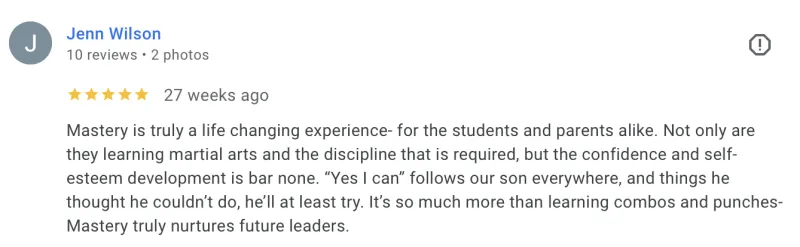
Many parents hope martial arts will help their child become more confident and disciplined — but what truly stands out is when those changes begin showing up in everyday life outside the dojo as well.
That’s why this review from a Cumberland parent captures such an important part of the Mastery experience:
“The confidence and self-esteem development is bar none. ‘Yes I can’ follows our son everywhere, and things he thought he couldn’t do, he’ll at least try.”
One of the greatest gifts a child can develop is the willingness to believe in themselves enough to try hard things, step outside their comfort zone, and keep growing through challenges.
At Mastery Martial Arts Cumberland, our mission is to help children build confidence, resilience, leadership, and emotional strength through structured martial arts training and positive mentorship.
As this parent shared:
“Mastery truly nurtures future leaders.”
Read the full parent review here:
see this Mastery school on Google
Start Here: Free Parent Resource
If this message resonated with you, begin with this simple step.
The No Yelling Challenge
A free guide to help you become more aware of your reactions and respond with clarity instead of frustration.
Because the most powerful transformation your child experiences starts with you.