The Ultimate Guide to Kids Martial Arts: How to Transform Your Child's Anxiety Into Unshakeable Courage
The Ultimate Guide to Kids Martial Arts: How to Transform Your Child's Anxiety Into Unshakeable Courage
If you're reading this, you already know the feeling.
It's that quiet worry that settles in when you watch your child struggle. Maybe they freeze up on the playground when another kid gets too close. Maybe they say "I can't" before they've even tried. Maybe they come home quieter than usual, and when you ask what happened, they shrug and disappear into a screen.
You're not imagining it. And you're not alone.
Today's children are navigating a world that's genuinely harder than the one most of us grew up in. Social media comparison, academic pressure, bullying both in person and online — these forces chip away at a child's self-worth every single day. According to the CDC, approximately 1 in 5 children ages 3–17 now has a diagnosed anxiety disorder. The Annie E. Casey Foundation reports that nearly 1 in 3 youth ages 12–17 had a mental, emotional, or behavioral health condition.
These aren't just statistics. These are our children.
As a parent, you're not looking for another after-school activity to fill a Tuesday afternoon. You're looking for something that will genuinely transform your child from the inside out.
That's exactly what Mastery Martial Arts was built to provide.
We're not just a martial arts school. We're a School of Life — built on the philosophy of Mental Health in Motion: the belief that the most powerful transformations happen when disciplined physical training meets intentional character development.
In this guide, we'll walk you through every dimension of what martial arts does for a child — the science, the psychology, and the real-world outcomes parents witness every week on our mats.
Chapter 1: Understanding Your Child's Nervous System
The Hidden Battle Happening Inside Your Child
Before we talk about kicks and belts, we need to talk about something far more fundamental: your child's nervous system. This is the command center for everything — their emotions, their behavior, their ability to focus, and their capacity for courage.
The nervous system operates in two primary modes:
The parasympathetic state— "rest and digest" — is where a child is calm, clear-headed, and capable of learning, connecting, and making good decisions.
The sympathetic state— "fight or flight" — is where stress hormones flood the body, the thinking brain goes offline, and survival instinct takes over.
The problem? Modern life is full of triggers that push children into that fight-or-flight state — and many of them never fully come back out. A harsh word from a peer. A difficult test. A social situation they don't know how to navigate. Over time, a child who lives primarily in this state becomes easily overwhelmed, avoids challenges, lashes out in frustration, or shuts down entirely. They become the child who says "I can't" before they even try.
Signs Your Child's Nervous System Is Overwhelmed
Parents often mistake these patterns for personality traits or behavioral problems. They're not. They're signals.
Signs of an Overwhelmed Nervous SystemSigns of a Regulated, Courageous Nervous SystemSays "I can't" before attempting a challengeAttempts challenges with curiosity and persistenceMelts down over transitions and unexpected changesAdapts to new situations with relative easeWithdraws from social situations or clings to parentsEngages peers with confidence and warmthLashes out physically or verbally when frustratedPauses, breathes, and responds rather than reactsAvoids eye contact and speaks in a small, uncertain voiceHolds eye contact and speaks with clarity and volume
If you recognize your child in the left column, their nervous system is asking for help.
How Martial Arts Flips the Switch
At Mastery Martial Arts, everything we do is built around one central goal: teaching children to move from a state of fear to a state of courage — not by suppressing fear, but by giving them the tools to regulate their nervous system and act in spite of it.
This isn't motivational language. It's physiology.
Controlled, rhythmic physical movement activates the parasympathetic nervous system. Structured breathing signals to the brain that the threat has passed. The repetitive nature of martial arts drills creates a sense of mastery and predictability that is profoundly calming for an anxious child.
Over time, consistent training develops what researchers callself-regulatory capacity— the ability to manage one's own emotional and physiological states. A landmark study published in theJournal of Applied Developmental Psychologyfound that school-based martial arts training produced significant improvements in children's cognitive self-regulation and classroom conduct.
The transformation parents witness is nothing short of remarkable. The child who walked in saying "I can't" begins to say "Yes, I can." That's not cheerleading. That's the result of a structured, evidence-informed process of nervous system training.
Chapter 2: The Mental Health Benefits — What the Science Actually Says
Why Movement Is Medicine
The mental health crisis among children is real and urgent. Rates of anxiety and depression in young people have been rising steadily for over a decade, and traditional interventions — while valuable — aren't always enough, especially for kids who struggle to sit still and articulate their feelings.
This is where Mental Health in Motion becomes a game-changer.
Physical exercise releases endorphins, reduces cortisol, and promotes the growth of new neural connections. But martial arts goes further than ordinary exercise. It combines physical exertion with mindfulness, structured social interaction, and the progressive mastery of skills — creating a therapeutic environment that addresses the root causes of anxiety, low self-esteem, and poor emotional regulation at the same time.
The American Academy of Pediatrics has noted that a growing body of research points to significant benefits for children who participate in martial arts, including reduced stress, improved fitness, and better school performance.
Martial Arts and ADHD: Building Real Focus
One of the most common reasons parents seek out martial arts is attention and focus. For children with ADHD, most activities either exhaust their energy without channeling it, or fail to hold their attention long enough to matter.
Martial arts is different.
ADDitude Magazine reports that complex physical activities like martial arts strengthen neural networks and give kids with ADHD a structured way to practice self-control. A study published through the National Institutes of Health found that martial arts training enhances attentional control due to the combination of focused attention, mindfulness exercises, and cognitive demands inherent in the practice. A separate study in theJournal of Experimental Child Psychologyfound that martial arts improves working memory and attention in school-aged children more effectively than non-cognitive physical exercise.
The structure of a martial arts class is uniquely suited to the ADHD brain. Instructions are short and clear. Demonstrations are visual and kinesthetic. The pace is quick enough to stay engaging. When a child loses focus, instructors redirect them with a physical cue rather than a verbal reprimand — so the child is never made to feel deficient, just re-engaged. Over time, this builds genuine attentional capacity that carries over into the classroom and the home.
The Academic Connection Most Parents Don't Expect
Many parents are surprised to learn that martial arts training has a direct, measurable impact on academic performance.
A study published in theInternational Journal of Environmental Research and Public Healthfound that children practicing martial arts showed better executive functioning and higher school marks than peers in team sports or sedentary activities. A separate school-based karate study found that a one-year program was effective in improving academic achievement and reducing conduct problems in primary school children.
The connection makes sense when you think about it. The skills that make a great martial artist — focus, discipline, persistence in the face of difficulty, the ability to follow multi-step instructions — are the exact same skills that make a great student. The mat is a training ground for the classroom.
Overcoming Shyness and Social Anxiety
For a shy child, every new environment is a potential source of embarrassment. Every group activity is an opportunity to be exposed as awkward or unwanted. These children aren't antisocial — they desperately want connection. They just haven't been given the tools to pursue it without fear.
The dojo is built to change that.
From the moment a child walks through the door, they're greeted by name. The class structure removes the ambiguity that makes unstructured social situations so overwhelming. Partner drills give shy kids a low-pressure way to connect — they're focused on a shared task, which takes the spotlight off the social interaction itself.
Research published in theCanadian Journal of Behavioural Sciencefound that shy children who participated in organized sports for one year showed a significant decrease in social anxiety compared to shy peers who didn't participate. Martial arts, with its mentorship-rich and structured environment, is particularly well-suited to producing this outcome.
Building Resilience Before the Teenage Years Hit
The teenage years bring their own set of challenges: comparison culture, academic pressure, romantic rejection, peer influence. A child who enters adolescence without a strong sense of self-worth and the capacity for resilience is genuinely vulnerable.
A study published through the National Institutes of Health found that physical activity significantly enhances psychological resilience and mental health in adolescents, helping them manage challenges across multiple life domains.
Martial arts builds this resilience systematically. The belt progression teaches children that real achievement requires sustained effort — there are no shortcuts. Every time a child fails to break a board, struggles with a new technique, or loses a sparring match, they're given the opportunity to practice the most important skill of all: getting back up.
By the time a child trained in martial arts reaches adolescence, they've accumulated hundreds of experiences of overcoming failure. They know, in their bones, that they can handle hard things. That knowledge is the most powerful armor a parent can give their child.
Chapter 3: The Physical Benefits — Strong Bodies, Strong Minds
The Screen Time Crisis
The decline in physical activity among children demands urgent attention. A study published through the National Institutes of Health found that nearly 60% of children who exceeded seven hours of daily screen time did not meet physical activity guidelines. Most American children spend between five and seven hours per day in front of screens. We are raising the most sedentary generation in human history — and the consequences for both physical and mental health are severe.
Martial arts is one of the most effective antidotes available. Children don't experience it as exercise. They experience it as an adventure. They come to class excited. They leave energized. And because the curriculum is always progressing, there's always a new skill to master, a new challenge to pursue, a new belt to earn. The motivation to keep coming back is built into the structure of the program itself.
What Happens to the Body
The movements required in a typical martial arts class — stances, strikes, kicks, blocks, rolls, and partner work — develop coordination, balance, spatial awareness, reaction time, and fine motor control. These aren't just martial arts skills. They're foundational physical literacy skills that benefit a child in every physical domain.
A systematic review published through the National Institutes of Health found that martial arts programs consistently improved physical fitness in preschool and school-age children, including strength, flexibility, coordination, and cardiovascular endurance. A child who trains in martial arts becomes a better soccer player, a better dancer, a better swimmer. They move through the world with greater body awareness and significantly fewer injuries.
Habits That Last a Lifetime
The discipline of martial arts extends well beyond the dojo. Children who train consistently begin to understand the connection between how they treat their body and how they perform. They start making better choices about sleep. They pay attention to what they eat — not because they're told to, but because they can feel the difference.
These habits, formed in childhood, have lifelong consequences. A child who learns to respect their body through martial arts is far more likely to carry healthy habits into adulthood, reducing their long-term risk of chronic disease and maintaining the mental health benefits of regular physical activity for life.
What a Class Actually Looks Like
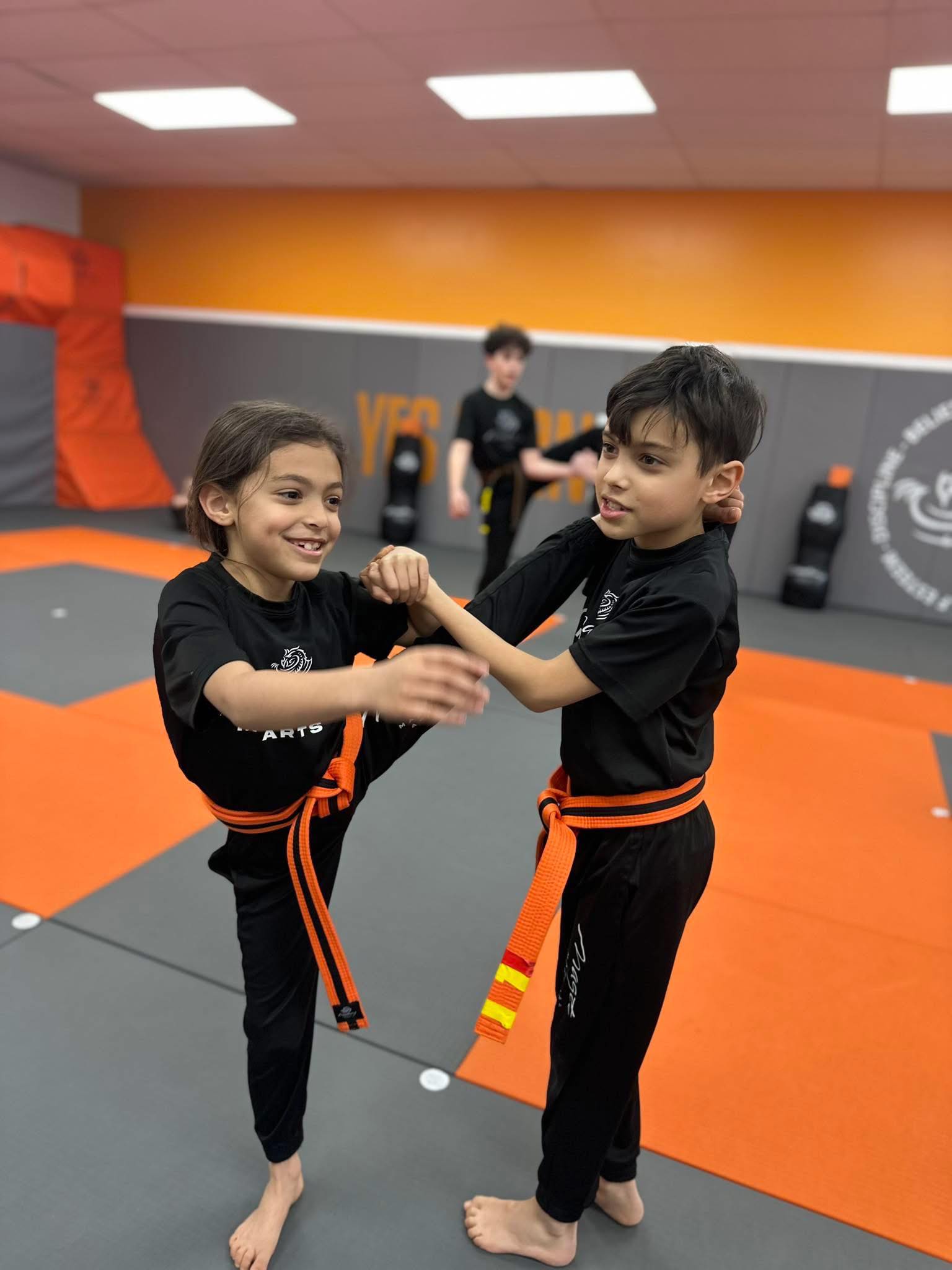
A well-structured martial arts class for children begins with a warm-up: cardiovascular exercise, stretching, and coordination drills. This is followed by technique instruction, then partner work where children apply what they've learned in a controlled, cooperative setting. Classes typically close with a cool-down, a brief mindfulness exercise, and a character lesson that reinforces the life skills curriculum.
In one hour, a child will have elevated their heart rate, stretched every major muscle group, practiced fine and gross motor skills, engaged in meaningful social interaction, and received a lesson in a core value. No other after-school activity delivers this range of benefit in a single session.
Chapter 4: Bully-Proofing Your Child — Real Self-Defense for the Modern World
The Reality of Modern Bullying
Bullying is one of the most common fears parents carry — and the data confirms it's well-founded. According to StopBullying.gov, approximately 19.5% of students ages 12–18 experience bullying nationwide. Over 40% report it happening online or via text, adding a digital dimension that makes it nearly impossible to escape. A Pew Research Center survey found that 64% of U.S. parents with children under 18 are extremely or very worried their child will be bullied.
The psychological consequences are severe and lasting: higher rates of anxiety, depression, academic difficulties, and social withdrawal that can persist well into adulthood. You can't simply hope your child won't be targeted. You have to prepare them.
The First Line of Defense: Confidence and Assertiveness
At Mastery Martial Arts, we teach children that true self-defense begins long before any physical contact occurs. It begins with how you carry yourself.
A child who walks with their head up, shoulders back, and gaze direct communicates something powerful:I am not an easy target.Bullies — like most opportunists — look for children who appear uncertain, isolated, or easily overwhelmed.
We teach children to project confidence through body language and voice. We teach them to set clear verbal boundaries — to say "Stop. I don't like that" with a firm, calm voice and to mean it. We teach situational awareness: how to read a social environment, recognize when a situation is escalating, and remove themselves from danger before it becomes physical.
These are life skills that serve a child in every environment they'll navigate for the rest of their life.
Physical Self-Defense: Knowing You Can Protect Yourself
Despite our best efforts at prevention, there are moments when a child may face physical aggression. The techniques taught in our program are specifically designed for real-world child safety scenarios: breaking common grips and holds, creating distance from an aggressor, protecting vital areas. Every technique is taught with a clear emphasis — the goal is to stay safe and get away, not to fight.
This knowledge does something profound to a child's psychology. Knowing they have the tools to protect themselves reduces their baseline anxiety in social situations. They no longer walk into a school hallway wondering "what if?" They walk in knowing they have a plan. That confidence is visible — and it's itself a deterrent.
Will Martial Arts Make My Child More Aggressive? (The Research Answers This.)
This concern holds many parents back — and it deserves a direct, evidence-based answer.
The research is unequivocal: martial artsreducesaggression.
A meta-analysis published inAggression and Violent Behavior, reviewing twelve studies on the effects of martial arts on child and youth aggression, found that martial arts had a significant impact in reducing aggression — with eleven of the twelve studies showing a positive effect. A study published through the National Institutes of Health found that self-control and emotion regulation mediate the impact of martial arts training, meaning the training works by building the internal capacity to manage impulses. A separate study found significantly lower aggression and higher self-discipline in adolescents who trained in martial arts compared to those who did not.
The reason is straightforward. Martial arts teaches children that physical power comes with profound responsibility. The dojo is a place of deep respect. Striking a partner outside of a controlled, consensual training context isn't just against the rules — it's a fundamental violation of the values that martial arts instills.
Children who train in martial arts learn to channel their energy into productive physical activity. They develop the emotional regulation to de-escalate rather than escalate. They become, paradoxically, the most peaceful kids in the room.
Chapter 5: The Mastery Martial Arts Difference — A School of Life
What Sets Us Apart
There are plenty of places where your child can learn to kick and punch. There is only one Mastery Martial Arts.
The difference isn't in the techniques we teach — it's in the philosophy behind everything we do. The physical training is genuinely valuable. But the "Mastery" aspect is where the real transformation happens. The life skills curriculum, the character development, the mentorship, the community — these are what prepare your child not just for the mat, but for life.
What You Get at a Typical Martial Arts SchoolWhat You Get at Mastery Martial ArtsPhysical techniques and belt progressionPhysical techniques and belt progressionBasic discipline and focusDeep character development through a School of Life curriculumFitness and coordinationFitness, coordination, and nervous system regulation toolsA sportA second home and a lifelong communitySelf-defense skillsSelf-defense skills plus the courage to use them and the wisdom to avoid needing themAn instructorA mentor who knows your child by name and invests in their growth
Our Five Core Pillars
Every class at Mastery Martial Arts explicitly teaches and reinforces five values:
Respect is the foundation. Children learn to respect their instructors, their training partners, their parents, and themselves — not through fear, but through genuine understanding of why it matters.
Courtesy teaches children how to move through the world with grace and consideration. In a culture that increasingly rewards rudeness, a child who knows how to be genuinely courteous stands out in the best possible way.
Perseverance may be the most critical life skill we teach. Every child will face moments on the mat when they want to quit. We teach them to stay — because the moment they want to quit is exactly when real growth begins. This lesson, lived on the mat, transfers to every challenge they'll ever face.
Integrity means doing the right thing when no one is watching. We teach children to train with full effort whether the instructor is observing or not, and to treat their training partners with care even when frustrated. This is the foundation of trustworthy character.
Indomitable Spirit is the culminating value — the unshakeable belief that no matter what life throws at you, you have the inner resources to face it. This is the courage system fully activated. This is the child who says "Yes, I can" not because the task is easy, but because they know they are capable of hard things.
Our Instructors: Mentors Who Change Lives
The quality of any martial arts program comes down to the quality of its instructors. At Mastery Martial Arts, our instructors aren't just technically skilled martial artists — they're trained mentors who understand child development, learning differences, and the art of positive reinforcement.
They know every student by name. They know which child needs extra encouragement, which needs a gentle challenge, and which needs a specific training partner to bring out their best. They hold high standards with warmth and humor, and they genuinely celebrate every student's progress.
Many of our instructors were once students who found their own transformation on the mat. They know firsthand what it feels like to walk in uncertain and walk out courageous — which makes them uniquely qualified to guide your child through the same journey.
The Community: Your Child's Second Home
One of the most underappreciated benefits of martial arts is the community it creates. The dojo brings together children of different ages, backgrounds, and abilities around a shared purpose. Older students mentor younger ones. The culture of mutual encouragement isn't a nice-to-have — it's a fundamental part of the training.
For a child who feels like they don't belong anywhere — too sensitive for the rough-and-tumble of team sports, too restless for a chess club, too different for the mainstream social groups at school — the dojo can be a revelation. Their intensity becomes an asset. Their sensitivity is respected. Their unique strengths are seen and celebrated.
It is, quite simply, a second home.
Chapter 6: Is Your Child Ready? Signs, Age, and How to Begin
What Age Should My Child Start?
Most children are developmentally ready to begin martial arts training around age 4 or 5. At this age, children are developing fundamental motor skills and social-emotional awareness, making it an ideal time to introduce them to a structured, playful environment.
That said, every child is different. A child who can follow simple two-step instructions, separate from a parent comfortably, and engage in group activities is generally ready. Our introductory classes meet young children exactly where they are, using games, stories, and age-appropriate challenges to introduce foundational concepts in a way that feels joyful — not intimidating.
For older children just starting out: there is no disadvantage to beginning at 8, 12, or even older. The benefits are available at every age. An older child often brings a greater capacity for focus and self-reflection, which can actually accelerate their early progress.
Signs Your Child Needs This Now
While any child can benefit from martial arts, certain signs suggest a child may need it urgently — signs that their nervous system is asking for help:
The child who struggles with simple tasks— melting down over homework, refusing chores, unable to transition between activities without a battle — needs the structure and regulation tools that martial arts provides.
The child who gives up quickly— saying "I can't" before trying, abandoning new activities at the first sign of difficulty — needs the perseverance and self-efficacy that martial arts builds.
The child who lacks confidence— reluctant to speak up, deferring in social situations, shrinking in new environments — needs the progressive mastery experiences that martial arts provides.
The child retreating into screens— choosing virtual interaction over real-world connection to avoid social anxiety — needs the embodied, in-person community the dojo provides.
The child who seems anxious or fearful— excessive worry, stomachaches before school, easily startled — needs the regulation tools that consistent martial arts training provides.
The child who is struggling socially— being bullied, having difficulty making or keeping friends, feeling like they don't fit anywhere — needs the confidence, community, and self-defense skills that martial arts provides.
If you recognize your child in any of these descriptions, the time to act is now.
Frequently Asked Questions
Is martial arts safe for my child?Yes. When taught correctly, martial arts is one of the safer structured activities available for children. Our classes emphasize proper form, technique, and safety protocols at all times. Instructors are trained in first aid and CPR, and every class is supervised.
How often should my child attend?We recommend at least two classes per week for consistent progress. We offer flexible scheduling to accommodate different family needs.
What should my child wear to their first class?Comfortable athletic clothing is fine for a first visit. Once enrolled, students wear a traditional uniform called a gi, which is included in the enrollment package.
What if my child wants to quit?This is one of the most important questions a parent can ask. The moments when a child wants to quit are almost always moments of significant growth — not a signal to stop, but a signal to push through. We work closely with parents to distinguish healthy challenge from genuine distress. In our experience, a child who sticks with training for three months almost always has a breakthrough — the day something clicks, when the dojo truly becomes their second home. That breakthrough is worth every hard day that preceded it.
Preparing Your Child for Their First Class
For an anxious child, walking into something new can feel overwhelming. Here's how to set them up for success:
Talk about it positively and specifically.Tell them they're going to a place where they'll learn to be strong and brave, where the teachers are kind, and where they'll meet other kids learning the same things. Avoid vague reassurances like "it'll be fine." Instead, give them a concrete picture: "You'll bow when you walk in. You'll learn a special way to stand. You'll practice some moves with a partner."
Acknowledge their nerves without amplifying them. It's okay to say: "I know it feels a little scary to try something new. That feeling is actually your body getting ready to be brave." This reframes anxiety as a signal of courage rather than danger.
Then let them walk in.Resist the urge to hover or speak for them. One of the most powerful things you'll witness is your child discovering they can handle something new on their own. That discovery is the beginning of everything.
The Parent's Role: You're Part of the Team
The transformation that happens on the mat is accelerated — or slowed — by the environment a child returns to at home. Parents who actively reinforce the values of the dojo see dramatically faster and more lasting results.
This doesn't mean becoming a martial artist yourself. It means using the same language at home. When your child faces a challenge and wants to quit, remind them what they learned on the mat. When they succeed at something difficult, celebrate it in terms of effort, not talent.
Research on growth mindset, pioneered by Stanford psychologist Carol Dweck, shows that the language parents use when praising children has a direct impact on their resilience and willingness to take on challenges. Children praised for effort ("You worked so hard on that") develop greater persistence and a healthier relationship with failure than children praised for natural ability.
Martial arts is built on this principle. The belt system is a tangible representation of effort over time. When your child earns a new belt, they know — in their bones — that they earned it. That is a fundamentally different experience from a participation trophy. It is the experience of genuine achievement.
Language That Supports the Transformation
Instead of saying...Try saying..."You're so good at that!""I love how hard you worked on that.""Don't worry, it's not a big deal.""That was hard. I'm proud of you for trying.""You can quit if you want to.""I know it's tough. What would your instructor say right now?""You're so brave.""I saw you feel scared and do it anyway. That's real courage.""You're the best in the class.""You're getting better every single week. I see it."
The Milestones to Watch For
The transformation doesn't happen all at once — it happens in a series of small, cumulative shifts that add up to something profound.
Month 1:Watch for changes in posture and eye contact. A child who begins to stand taller and look people in the eye is a child whose nervous system is starting to regulate. Watch for a slight increase in willingness to try new things, even outside the dojo.
Months 2–3:Watch for improvements in focus and follow-through at home. Attentional capacity built in the dojo begins transferring to homework and chores. Meltdowns decrease. Frustration tolerance increases.
Month 6:Watch for a significant shift in confidence and social engagement. Shy children begin initiating conversations. Easily overwhelmed children begin facing challenges with new calm. The dojo becomes a place they talk about with pride.
Year 1:Watch for the emergence of leadership. Children trained for a year often begin naturally mentoring newer students — offering encouragement, demonstrating techniques. This is the courage system fully activated. This is a child who has internalized the values of the dojo and begun living them in every area of their life.
The Investment: What You're Really Paying For
Martial arts training is an investment. It's not the cheapest after-school activity available. But when you understand what you're actually paying for, the value becomes undeniable.
You're paying for a program shown to reduce anxiety, improve focus, build resilience, and protect your child from bullying. You're paying for a community of mentors who know your child by name. You're paying for a set of life skills — perseverance, integrity, respect, indomitable spirit — that will serve your child for the rest of their life.
Compare that to the cost of anxiety therapy (estimated at $100–$200 per session by the American Psychological Association). Compare it to the cost of tutoring for a child struggling academically due to poor focus. Compare it to the immeasurable cost of watching your child enter adolescence without the confidence and resilience they need to thrive.
For many families, enrolling their child in Mastery Martial Arts is the single best investment they ever made in their child's future.
The Transformation Begins Today
Every journey begins with a single step. The parent who reads this and takes action — who schedules that first class, who walks their child through the door, who commits to three months — is the parent who will watch their child transform.
There is no perfect time. There is only now.
Your child's nervous system is asking for help. The courage system is ready to be activated.
Come and see what is possible.
Schedule your child's introductory lesson at Mastery Martial Arts today.
